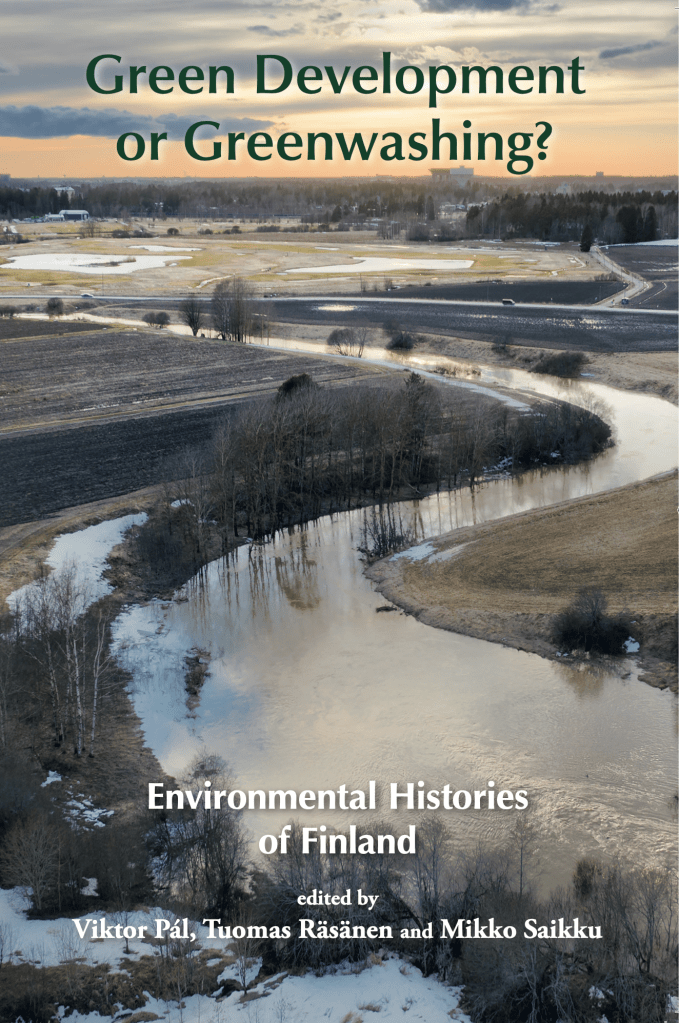
This edited volume by Viktor Pál, Tuomas Räsänen and Mikko Saikku is now available online and Open Access. It will be published in print on 15 October – and can be purchased from our online bookstore. The editors’ introduction to the volume is reproduced here to give readers a flavour of this ground-breaking collection.
Finland has been often labelled a ‘green superpower’. In 2016, according to the EPI (Environmental Performance Index) prepared by Yale and Columbia Universities, Finland was the world’s cleanest and greenest country.[1] Generally speaking, Nordic countries have tended to be idealised as ‘pristine and green’ compared to the rest of the rapidly contaminating world where the race for markets and profits has generated an accelerated level of consumption.[2] Environmental historians, however, can detect that the commonly perceived ‘greenness’ of the Nordic countries is partly an illusion. One of the most notable examples of histories in this vein is the recent volume by Peder Anker, who interprets Norway’s green development in the light of the country’s former peripheral position and shows how Norway has become a global green leader, while developing a robust petroleum industry and having some of the worst CO2 emissions per capita in the world.[3]
This volume states that Finland, like Norway, has evolved into being a green superpower at the price of considerable environmental problems: the current leadership position of Finland in sustainable development has been built on the heavy use of natural resources and at the expense of ecosystem health. Consequently, development and profit maximisation have had a significant and long-lasting negative impact on the natural environment in and around Finland. Old-growth forests have been replaced by intensive forest farming for lumber and pulp industries; more than half of wetlands have been drained for agriculture, forest cultivation and peat extraction; wild animal populations have been decimated; and Finland today is confined to the south and west by arguably one of the most polluted seas in the world.
The environmental harms of Finland’s development have been widely studied in a number of sustainability sciences. For example, regional environmental sciences approaches have sought to understand the societal reasons behind the pollution of the Baltic Sea,[4] and criticised the newly emerged consumer lifestyle and massive material footprints of members of Finnish society,[5] as well as cases where Finnish industry is globally involved in environmentally controversial issues – such as UPM’s involvement in Paso de los Toros in Uruguay, the world’s largest pulp mill.[6]
In Finnish historiography, however, the dominant narrative has portrayed Finland as an economic miracle built upon the country’s vast forest resources. This view may be valid when looking strictly from the human perspective of economic sustainability. Throughout the twentieth century, the wood processing industry was Finland’s largest import sector and source of foreign capital, while scientifically managed forestry enabled Finnish forest reserves to actually increase. Not least by exploiting forests, Finland developed from being one of the poorest countries of Europe at the start of the twentieth century into a prosperous welfare state.[7] This storyline, however, ignores the enormous impact this ‘economic miracle’ has had on the natural environment, with old-growth forests replaced by monocultures that were often planted on drained wetlands.
Pursuing this vein, authors contributing to this volume aim to take a pioneering path and argue that a complex set of social-economic-technological as well as environmental factors helped Finland to build an image as an eco-leader nation while retaining its extractive economic practices to develop first industrial, then post-industrial, capitalism. The authors suggest that, partly due to the harsh climatic conditions of the Northern, subarctic environments, as well as to a long history of economic and technological backwardness, the conditions and implications of the climate, forests and water resources have been some of the main subjects of discussion in Finnish scientific and cultural discourses since the onset of enlightened thinking in Finland in the eighteenth century. This trend expanded by the 1960s–1980s, during a period when Finland enjoyed continuous and unprecedented economic growth, albeit with a heavy toll on environmental quality.[8]
Consequently, we aim to re-evaluate the history of human-nature interactions in Finland, not only as a success-story of wise-use of the environment and the progress this entailed, but also in light of the country’s high CO2 emissions and ecological impact, half of which are generated by economic activity abroad. Instead of presenting a bucolic utopia, this volume aims to place some key aspects of Finnish environmental history under critical scrutiny.
The essays collected here suggest that the environmental history of Finland cannot be detached from global tendencies and an increasingly globalised world. Although the contributions cover diverse themes and introduce a wide range of aspects of human-nature relations, including the Sámi and Sápmi, forests, animals, pollutions, marine environment and politics, they are focused on key, globally relevant, layers of anthropogenic impact.
The chapters in Section 1 discuss the human perception and construction of the environment with a focus on Finland, beginning with Chapter 2, in which Jaana Laine analyses how the aims and activities of forestry and forest science reflected demands set by the state administration and forest industry, but also those of private forest and nature conservation organisations, as well as private citizens’ opinions, as represented, for example, in social media. To do so, Laine uses a longue durée approach, starting in the late nineteenth century and spanning to the 2020s, identifying four different and formative time periods. According to Laine, during the first period, between the late nineteenth century and the 1930s, Finnish science and state administration aimed to collect information on forests, especially about growing timber stock, which resulted in the first comprehensive Finnish forest inventory project in the 1920s. That increased knowledge and understanding contributed to increased wood consumption and exploitation of the forests by the late 1940s. Science and state actors promoted reforestation and widespread land reclamation projects to improve the timber removal and annual growth balance, from an economic perspective, during the coming decades. Laine argues that, from the 1970s, increased environmental concerns were included in public discussions about forestry, partly due to the growing awareness of conservation, recreation and other environmental values in forest science knowledge. Environmental discussions widened after the 2000s, when climate change and conflicting human-forest relationships posed new demands for Finnish forestry and forest science.
In the next chapter, Risto-Matti Matero analyses the rise of the concept of ‘green growth’ in a transnational environmental political debate, using the Finnish Green Party as a case study of how and why the concept was adopted. Matero argues that, during the 1990s, radical green visions disappeared from the Finnish Greens’ political discussions. This led to the green party adopting notions of economic growth and consumerism. Via the new mainstream party paradigm, consumers would affect the environment by making positive choices in free markets, thus creating green growth in the globalising world. From the perspective of the Finnish Greens, this ideological change was interpreted as an attempt to better adapt environmental politics into the political and economic paradigm of the country. Employing the Finnish case, Matero’s paper asks uncomfortable questions about the ideologies, goals and roles of environmentalist parties.
In Chapter 4, Seija A. Niemi investigates changing perceptions of birch trees in Finnish society over the past four centuries. Niemi argues that the economic importance of pine and spruce forests grew significantly because of the increased presence of the wood processing industry in Finland, whereas the birch tree experienced a different history. Niemi places the birch in socio-economic context, and examines the two-way, interspecies interactions governed on the human side by inherited language, attitudes and values. The author argues that the birch tree’s marginal economic importance led to a more holistic understanding of the tree and contributed to Finns’ high level of environmental literacy.
In the following chapter, Matti O. Hannikainen examines the classification of fish in Finnish society, and argues that the relationship between Finns and fish, as a food source, changed dramatically during the twentieth century. Over the past century some species of fish came to be labelled as ‘trash fish’ and Finnish consumers began to prefer both fresh and imported frozen fish, which drastically decreased the consumption of salted fish. Hannikainen explores how the concept ‘trash fish’, referring to species with little or no value for human consumption, gained prominence and in return affected the consumption of fish in Finnish society. The author uses textual analysis of official documents, fishing manuals, professional journal articles and cookbooks and pays particular attention to past scientific discourses that aimed at rationalising fishing by classifying species according to their commercial value.
Section 2 focuses on contested and colonised spaces and begins with Chapter 6 in which Maria Lähteenmäki, Oona Ilmolahti, Outi Manninen and Sari Stark investigate traditions of reindeer husbandry in Mid-Lapland via challenging the stereotypical images of Lapland. In the traditional home areas of the Forest Sámi, Lapland has undergone far-reaching environmental changes during the past few hundred years. Alongside environmental changes, that part of Lapland also underwent ethnic transition during the eighteenth and nineteenth centuries when Finnish settlers came into close contact with the Forest Sámi people. The Mid-Lapland area has been often seen by ethnic andsociocultural scholars as an uninteresting borderland. In opposition to that discussion, Lähteenmäki and Ilmolahti argue that the home of the Forest Sámi is a peculiar cultural area, which can be identified as the Mid-Lappish hybrid cultural region. That new notion may open fruitful research streams in the study of human–nature relationships.
In the next chapter Jukka Nyyssönen uncovers the recent environmental history of the multi-ethnic Inari area by analysing repeated disputes over resource use and the fate of reindeer-herding, in a context where logging and other land use forms have competed for the same areas. In the Inari area, expanding nature conservation areas have aroused local protests over feared restrictions to hunting rights and possibilities of logging the forest reserves. Interestingly, the Sámi herders remained positive towards the protected areas. Nyyssönen uses frame analysis to study the planning processes of the Lemmenjoki and Koilliskaira/Urho Kekkonen National Parks which took place in the 1950s, 1970s and 2000s. In his analysis, the author underlines that the Sámi manoeuvred the administrative setting with success and were able to use it as a resource in alignment with the planning officials.
In Chapter 8, Heta Lähdesmäki investigates changing forests and the perceived ‘proper’ place for wolves in twentieth century Finland. The author ventures out to investigate the case of Western Finland, where wolf packs are now observed after a long period of absence. According to Lähdesmäki, local people have argued that wolves should not live in Western Finland because there are no wilderness areas there. This reflects a perceptual frame in which many Finns see the wolf as a wilderness species. The author investigates the origin of this perception, while looking into wolves’ history in the Finnish context.
Mauri Soikkanen and Simo Laakkonen argue that environmental history is a new way to explore World War Two, and focus on the mobilisation of natural resources in the Finnish context. They seek to uncover the role of hunting and fishing during WWII. To achieve their objective, the authors examine hunting and fishing along the thousand-kilometre border between Finland and the Soviet Union and focus on the largest wilderness area in Europe where Finnish soldiers found an abundance of wildlife species, which was dramatically affected by ensuing armed conflicts in the area.
Section 3 collects contributions that focus on the human alternation of the environment. In Chapter 10, Janne Mäkiranta investigates urban air quality in Finland from the late nineteenth century to the late 1960s. This essay shows how nineteenth and early twentieth century concerns over urban air were based on the enduring thought that clean air was beneficial for health. During the twentieth century, this vague hygienic idea was replaced by a more specific view deriving from medical research in industrial environments. This transition was fostered by public health officials who saw scientific knowledge as a way to deal with increasing indignation over urban air quality in Finland. From the late 1950s onwards, air pollution measurements and medical research provided a detailed analysis of air quality. As a result, the concern about urban air was directed towards specific pollutants and their potential effects on health, and was embraced by the environmental critics of the late 1960s.
In the last chapter, Tuomas Räsänen examines the relationship between humans and wildlife in Finland during the long twentieth century. The author identifies three gradual changes in the human-nature relationship. According to Räsänen, the first such turning point arose in the late nineteenth century, when the government monopolised and institutionalised the control of wildlife and launched extensive campaigns to wipe out unwanted species, such as large carnivores and predatory birds. Dissenting voices that advocated the protection of at least some persecuted species grew louder during the first decades of the twentieth century. This new attitude culminated in 1923 with the enactment of the first law for nature conservation, in which several critically endangered species were protected. The continued killing of endangered species led to the third turning point in the 1960s and the 1970s, when Finns gradually began to cherish and celebrate wild places and the wildlife that occupied them. This turnaround was displayed in a completely new way of caring for and nurturing animals. However, the care for animals has been reserved for select species, while the rest have been left aside, so animal populations in some cases bounced back from their low points, but several animal species continued to decline.
In Seeing Like A State, James C. Scott’s influential book about the intersections of the natural environment and state intervention, Scott asserts that bureaucratic regimes aim to organise their societies according to the technocratic principles of ‘high modernism’, thus dooming their projects to failure and their societies to oppression.[9] For Scott ‘large scale capitalism is just as much an agency of homogenization, uniformity, grids, and heroic simplification as the state, with the difference that, for capitalists, simplification must pay’.[10] If this is so, it should not be surprising that Finland, despite its excellent record as a ‘green superpower’, has frequently prioritised exploitative practices over environmental concerns to achieve much desired economic prosperity. In the essays that follow, some commonalities emerge that unite environmental stories of Finland. First of all, contributions will reflect on accelerated ecological and societal changes, especially those of the last six or seven decades, which drastically remodelled human-nature relations in and around Finland. Second, most of the essays will juxtapose the duality of the cultural construction of the environment and the natural environment itself, which leads us to the third point – how the domestic social perception and the ‘exported’ images of nature in Finland seem to inhabit a diverging dichotomy from a grim reality, particularly in the post-1945 era.
This raises an interesting question: with a controversial and disturbing environmental history such as the ones reflected upon in the essays in this volume, can it be maintained that Finland has been an environmental success story, in other words a ‘green superpower’? Or perhaps, by looking behind the façade of greenwashing and social hypocrisy, there is a more layered and complex image to be found. It is the hope of the editors that the questions raised by the volume will inspire further research and eventually contribute to a less exploitative human-nature relations in the Nordic countries and globally, as well as more open and realistic societal discourses about pressing ecological problems in the Finnish backyard.
BIBLIOGRAPHY
Anker, P. 2020. The Power of the Periphery. Cambridge: Cambridge University Press.
Friends of the Earth Finland. On UPM-Uruguay mega investment and the responsibility of Finland to secure and monitor that it respects economic, social and cultural human rights in compliance with the ICESCR obligations (2017): https://maanystavat.fi/sites/default/files/attachments/upm-uruguay_mega_investment_and_responsibility_of_finland.pdf(Accessed 5 Oct. 2022).
Hasler, B., K. Hyytiäinen, J.C. Refsgaard, J.C.R. Smart and K. Tonderski. 2019. ‘Sustainable ecosystem governance under changing climate and land use: An introduction’. Ambio 48: 1235–1239.
Jalava, J., R. Asplund, J. Ojala and J. Eloranta. 2006. The Road to Prosperity: An Economic History of Finland. Helsinki: Suomalaisen Kirjallisuuden Seura.
Jarridge, F. and T. Le Roux. 2021. The Contamination of of the Earth. Cambridge, MA: MIT Press.
Kuisma, M. 2006. Metsäteollisuuden maa: Suomi, metsät ja kansainvälinen järjestelmä 1620–1920. Helsinki: Suomalaisen Kirjallisuuden Seura.
Lettenmeier, M., C. Liedtke and H. Roh. 2014. ‘Eight tons of material footprint – suggestion for a resource cap for jousehold consumption in Finland’. Resources 3: 488–515.
McNeill, J.R. 2001. Something New Under the Sun. New York: W.W. Norton & Company.
Scott, James C. Seeing Like a State. New Haven: Yale University Press, 1998.
Winiwarter, V. et. al. 2004. ‘Environmental history in Europe from 1994 to 2004: Enthusiasm and consolidation’. Environment and History 10 (4): 501–30.
[1] Socioeconomic Data and Applications Center: https://sedac.ciesin.columbia.edu/data/collection/epi/sets/browse
[2] For contamination and its causes worldwide, see McNeill 2001; Jarridge and Le Roux 2021.
[3] Anker 2020.
[4] Hasler et al. 2019..
[5] Lettenmeier et al. 2014.
[6] Friends of the Earth Finland 2017.
[7] E.g. Jalava et al. 2006; Kuisma 2006.
[8] Winiwarter et. al. 2004.
[9] Scott 1998.
[10] James C. Scott, ‘The trouble with the view from above’, Cato Unbound: A Journal of Debate: https://www.cato-unbound.org/2010/09/08/james-c-scott/trouble-view-above (accessed 15 March 2018).
 whitehorsepress