We are thrilled that Prudence Gibson has joined the Plant Perspectives team as Creative Submissions Editor, jointly with Kristina van Dexter. The journal’s first issue showcased exciting creative work and we are sure that, under Prudence and Kristina’s leadership, this element will flourish even more. The journal’s submission system is here.
In recent decades, artists and writers have been engaging with plants as intellectual drivers of new forms of critical thinking and creativity. Plants are no longer the inert subject of artists’ work. Plant aesthetics has become increasingly concerned with performative co-collaborations with and for plants, rather than representing them. This is a reaction against instrumentalisation (the thoughtless use of plants in domineering, capitalistic or patriarchal ways), and it is a methodology that seeks to avoid human use of plants for human gain, without care or consideration for the independent agency and rights of plants.

As a researcher in plant aesthetics, I address these challenges through a Dark Botany lens.
Dark Botany is the spirit of improving human-plant relations and of a better understanding of plants’ extensive and distributed value. There has been a noted move towards the ‘vegetal turn’ where new discoveries in science regarding plants’ capacity to learn, remember, decision-make and communicate have been evidenced. The ‘vegetal turn’ has impacted contemporary arts, including public, socially engaged and sound art, dance, performance, fiction and poetry.Dark Botany is a critical methodology that seeks to redress social and environmental inequities and illuminate past violence towards plants.[i]
Could this be the time to begin a new dark shimmering of plant aesthetics? A time that tilts outside chronology and glows with a new compounded force? Some of the issues of the plant-humanities are plant psychedelics, naming rights, land commons, custodianship, research ethics, copyright, plant imperial history, economic botany, plant poisons, robotany, capitalist plants and so on. All of these issues infuse current art praxes.
In my own research, such as recent books The Plant Contract (2018) and The Plant Thieves (2023) I have grappled with herbarium institutions’ Indigenous erasures and decolonising demands, with complex and contested nomenclature, with investigations of wastelands, wildlings, human-plant hybrids, bio-rights, ecofeminism, rhizomes and death. An ongoing question is whether we are still shaving too close to dominion or mastery over nature, or whether we are slipping back into dangerous re-colonising gestures that create no change.
As Creative Submissions Editor of Plant Perspectives, I hope to collaborate with artists and writers to deal sincerely with the corruption of the natural world. I hope to follow the creeping hands of vegetal time. I hope to find shallow leaf recesses where water can gather, to listen when the casuarinas moan, to read the fallen leaves when it’s time to harvest seeds. I hope, through this journal’s creative works, to help return us to the vegetal realm.
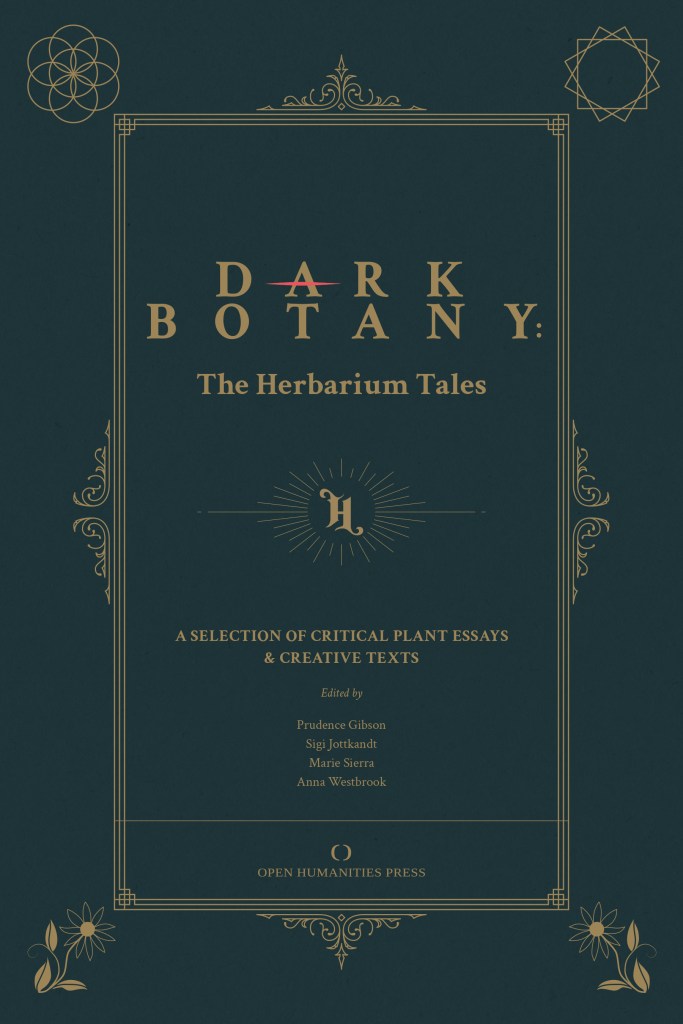
[i] Gibson, Prudence, Sigi Jottkandt, Marie Sierra, Anna Westbrook (eds). Dark Botany: The Herbarium Tales, Open Humanities Press, June 2024.
 whitehorsepress