In today’s blog, Emma Moesswilde takes her recently published article in Environment and History, Practising Cold Weather: English Agricultural Discourse and Memory, 1739–1800 (online first, September 2024) as a jumping off point to discuss memory and forgetting of extreme change, and the opportunity to become a more empathetic historian.
Historians who scour the past to uncover relationships between human history and climate change often seek a certain degree of certainty. What was the temperature of a particularly extreme season, and how does it compare to the twentieth-century global average? What was the yield of a wheat field, or the price of flour, or the number of deaths by starvation? What policies or actions can be identified as a result of a climate anomaly or regime? And what actionable lesson can be learned from these findings? In 2021, in the depths of a cold and snowy winter, I found myself drawn to the story of another chilly season: the winters of the early 1740s, sometimes called ‘The Great Frost’ in England. I read eighteenth-century accounts of urine frozen in chamber pots, lambs frozen in fields and outbreaks of disease and unrest as I followed twenty-first century stories of insurrection, eagerly awaited my first vaccine against Covid-19, and kept up with friends, family and colleagues via Zoom. It seemed that this season would never end.

At the same time, though, as the days grew ever so slightly longer, I knew that this, too, would pass, as had the cold and dry winters of the early 1740s in England. As I searched through digitized materials for accounts of this climate episode, most of what I could find were retrospective descriptions of the searingly cold weather, likely due to a stalled zone of high atmospheric pressure over the British Isles, and drought whose cause is as yet unknown. Phenologist Robert Marsham, who recollected the winter of 1739–1740 in his diary, recalled ecological disruption from the cold, as well as rural hardship and food scarcity, but also emphasised the importance of the successful Norfolk barley crop in supplementing grain supplies in England and Western Europe that year. Several years after the initial extreme winter, William Ellis, the prolific agricultural writer whose publications predated the surge of agrarian publication in the late eighteenth century by the likes of Arthur Young, began to recall the adaptation measures employed by rural Hertfordshire populations during crop failures brought about by cold and short growing seasons in 1740.
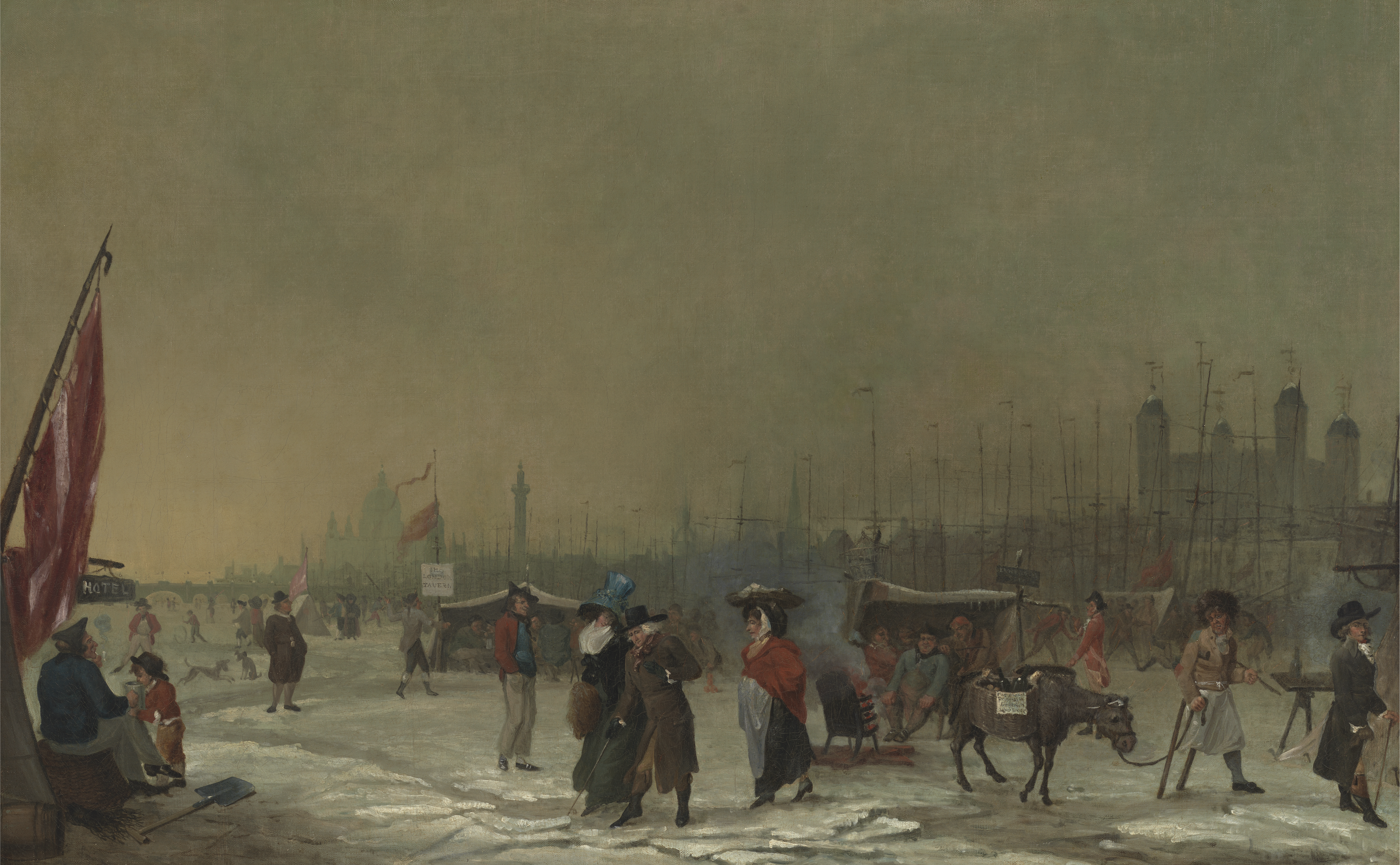
For a historian interested in the relationship between climate change and qualitative agricultural practice, Ellis’ and Marsham’s recollections were a goldmine. Here was evidence of climate shaping agricultural techniques and daily life, I thought triumphantly between double-masked trips to the grocery store and dog walks where snow trickled into my boots. Ellis’ publications cited the 1740s when recommending agricultural techniques such as hoeing, the planting of cover crops and the incorporation of barley into bread recipes. Yet, as agricultural print culture accelerated after the 1760s, references to past climate changes such as those of the 1740s declined. From what I could see, even the drought and cold of the 1790s in England alongside persistent efforts for agricultural change did not spark a return to referencing earlier climate anomalies and improved strategies of husbandry in the face of chilly, dry conditions. Rather, techniques such as cultivating vetches, rape and hay as auxiliary fodder crops in the case of an early turnip crop failure, which Ellis had recommended in the 1740s, were espoused in the 1790s without any discussion of their previous utility in extreme climate conditions. The persistence of agricultural knowledge which may have been gained in the 1740s as a response to extreme climate variability emphasised how resilient responses to climate change could shape agricultural innovation and persist in collective memory. Yet the lack of reference to the period of climate change itself pointed to forgetfulness as well as recollection.
The forgetting or deemphasizing of environmental changes such as extreme cold and drought may have been a method of processing the trauma of uncontrollable environmental change, something which scholars have also discussed in the context of pandemic disease across human history. It may also indicate the normalization of extreme weather which characterised much of the centuries-long global climate regime known as the Little Ice Age. Finally, such forgetting highlights the importance of the human lifespan as timescale – perhaps it is not a coincidence that William Ellis, whose references to the 1740s enriched his agricultural writing, died in 1758. Yet the persistence of eighteenth-century agricultural techniques resistant to cold and drought demonstrates that the fading of explicit references to the 1740s in agricultural discourse does not necessarily signify a complete forgetting, but rather a transformation.
When I think back on the process of writing about the 1740s, my own memories swirl between multiple pasts. Endless quotes about the utility of barley as a cold-resistant crop mingle with the sensory memory of piling on three sweaters against the bone-cracking cold of a New England winter. Revelations about the importance of hoeing, rather than ploughing, to preserve soil moisture jostle alongside recollections of waking up in the dark to write, the snow outside glowing white in the blackness as I brewed my first cup of tea. The environments and sensations about which I wrote seemed just as challenging and interminable as the process of research, the uncertainty about the state of American democracy, the assurance that one day the snow would melt and I would receive a vaccine that would enable me to return to a physical archive. Now, writing in 2024, I marvel even more at the resilience of populations in eighteenth-century Herefordshire and Norfolk and populations in the twenty-first century global populations across the globe, responding to ecological and social disruption.
My goal in reflecting on the content and process of writing this article is not to suggest that my own experiences, nearly three hundred years and thousands of miles removed from the people and landscapes about which I write, opened a hitherto-unaccessed portal to the past. Rather, when I think about the layers of memories between my historical subjects and myself, the synergies between past and present offer me the opportunity to be a more empathetic historian. It can be tempting to focus on the concrete and material impacts of climate change in the human past – crop failures, mortality, dearth – and the empirical data which indicates those changes. The recollections of a Herefordshire housewife who baked bread with barley, or the persistent memory of dry soil and failed crops which caused a Norfolk farmer to continue to hoe his beans, are harder to retrieve and pin down, as are my own memories when I look back on a cold pandemic winter. The endeavour of doing so, and the resonance when the experiences of the past chime with those in the present, is well worth the effort.

 whitehorsepress