In this blog Thomas Storey develops the ideas on the entanglement of technology and ecology in his recently published article in Plant Perspectives, ‘Media Ecologies and Transcendent Technology in Richard Powers’s “The Overstory”’ (December 2024).
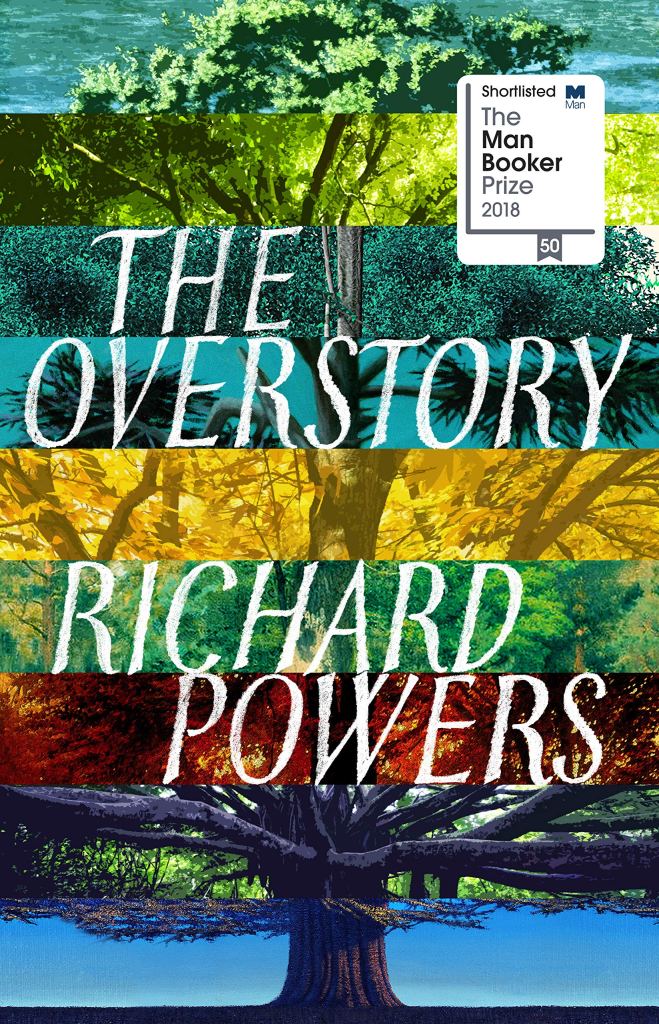
Richard Powers’s 2018 novel The Overstory is regarded as one of the central texts of contemporary ‘eco-lit’, a genre that addresses our contemporary state of ecological crisis. Beyond the quality and scope of the work itself, there are a number of contextual factors that may have helped propel Powers’s novel to this position of prominence. Firstly, it was published at a time when the discourse of environmentalism, and the battle against climate change, was at a relative high point in the popular consciousness. Released three years after the Paris Agreement had established 1.5 degrees of warming as a limit the planet would not be allowed to cross, The Overstory rode the subsequent wave of widespread (and short-lived) optimism about our ability to successfully mitigate the worst effects of climate change.[1] Reflecting on that time now, when climate optimism has been significantly eroded, The Overstory’s hopeful narrative of environmental conservation seems a relic of a path not taken, rather than a possible future.

A further reason for The Overstory’s success was that it was inspired by a scientific concept with widespread popular appeal: the notion of trees being able to communicate through the mediation of a network of fungi, a phenomenon variously dubbed ‘Nature’s Internet’ and the ‘Wood Wide Web’. This idea had leapt the bounds of academic research to prominence in mainstream science journalism and commentary, perhaps because it spoke to concepts of entanglement that were emerging from environmental discourse.[2] The Overstory, by dramatising such entanglement, made this idea’s cultural cachet apparent. Moreover, in taking these ideas as a starting point, The Overstory mirrored the technological metaphors and ideas that underlay the framing of this idea as ‘Nature’s Internet’. Indeed, this technological focus went further: as well as ecological interconnection, The Overstory is concerned with the ways in which technology mediates and modulates the connections between human and nonhuman. This relation is given an intriguing valence in The Overstory, which makes the book’s socio-political implications more complex than they may initially appear.[3]
At the same time as it criticises industrial technology as the primary vector for extractive capitalism’s destruction of the biosphere, The Overstory identifies digital technologies as a possible means of transcending that model of human development and adopting a more reciprocal relation with the natural world. Powers’s insistence on digital technologies as the vehicle for ecological knowledge and communication, a vehicle with apparently transcendent, posthuman implications, overlays and extends the novel’s environmental message. By the end of the novel, it is suggested that algorithmic systems will function like what one character calls a ‘growing organism’ to provide a ‘venture into cooperation’, in which ‘creatures swallow up whole continents of data’ based on pre-existing ‘digital germplasm’ – these ‘creatures’ being computer programmes. The aim of such a bio-technological data-gathering system will be to ‘find out how big life is, how connected, and what it would take for people to unsuicide’.[4] As such, Powers anticipates the recent rise of AI, as his algorithmic ‘learners’ are autonomous systems capable of some form of techno-organic intelligence.[5] The possibility that AI systems will help ‘solve’ the climate crisis, as has been put forward by many AI proponents, appears to be one that The Overstory would endorse.[6]
In this valorisation of technology, in which it appears to be the necessary pathway out of environmental crisis, Powers at times appears to echo the strain of ecological thought known as ‘ecomodernism’, underlying which is the claim that ‘meaningful climate mitigation is fundamentally a technological challenge’. ‘The Ecomodernist Manifesto’ of 2015, authored by such stalwarts of the techno-ecological liberal nexus as Stewart Brand and Ted Nordhaus, among others, states that ‘humanity must shrink its impacts on the environment to make more room for nature’, but also rejects the notion that ‘human societies must harmonize with nature to avoid economic and ecological collapse’.[7] Instead of social change, ecomodernism sees technological intensification as the pathway towards climate mitigation. It therefore rejects what Jonathan Symons calls ‘Green localism’ in favour of ‘continuous technological innovation’, conceived of as a means of abating or reversing the worst effects of climate change.[8] Ecomodernism, as with The Overstory, emerged from the fraught, but relatively optimistic, environmental discourse that characterised the 2010s, and was underpinned by a similar valorisation of the transcendent potential of technology. The movement also shares with The Overstorya focus on the failures of radicalism as a means of countering extractive industry, although in Powers’s novel the possibility that radical action may still be required is left open.
However, Powers’s determination to fuse his technological valorisation with a commitment to environmental entanglement marks his thinking out from that of the ecomodernists. Powers’s own statements about the relation between nature and technology are worth quoting here, as they shine a light on the way in which his vision differs. In an interview with Gulf Coast, he argues that
to be human is already to have a relationship to technology, and the transformation of the rules of living on earth. It’s one of the distinguishing features of our species, that we manipulate tools and that we create and project our powers with various leveraging devices, that change the terms of time and space for us. And we’ve been doing that from the beginning. In fact, the very most powerful technologies in the human drama are often the earliest ones. When you think of fire, to flint-knapping, all the way down to writing, every one of these technologies is a huge revolution that transforms our own sense of what we’re capable of doing, and what we want to do.[9]
For Powers, as The Overstory and some of his other works make clear, technology use is a predicate of being human; it is through technology that we embark on new ways of shaping our human identity. In The Overstory, digital technology is depicted as a possible means of overcoming human exceptionalism, in favour of a more reciprocal relation to the nonhuman world, one that makes apparent how entangled our species wellbeing is with other lifeforms. Unlike the ecomodernists, Powers doesn’t see technological intensification as a way of resolving the climate catastrophe through the continued elevation of the human above and beyond the nonhuman, but as a means of reversing that elevation and deepening our relation to the wider world. If we are able to ‘unsuicide’, as Powers puts it, deepening technological intensification in autonomous systems is necessary to provide the epistemological and ontological tools needed to remedy the negative impact humans have had on the biosphere. That is why The Overstory remains an essential piece of ecological writing, as it suggests how we can use the technological tools at our disposal to counter extractivism and, instead of fostering exceptionalism, embrace entanglement and interconnection.
Plant Perspectives needs your help: find out how you can help to keep the journal Open Access without compulsory author fees
[1] For a full examination of the contemporaneous discourse in climate policy, and a dissection of what subsequently occurred, see Wim Carton and Andreas Malm, Overshoot: How the World Surrendered to Climate Breakdown (London: Verso Books, 2024).
[2] An overview of this vein of scientific inquiry and its impact can be found in Robert Macfarlane’s ‘The Secrets of the Wood Wide Web’, The New Yorker, 7 Aug. 2016: https://www.newyorker.com/tech/annals-of-technology/the-secrets-of-the-wood-wide-web
[3] These ambivalences and themes are explored in my article in Plant Perspectives: Thomas Storey, ‘Media Ecologies and Transcendent Technology in Richard Powers’s “The Overstory”’, Plant Perspectives, Dec. 2024, https://doi.org/10.3197/whppp.63845494909747
[4] Richard Powers, The Overstory (New York: W.W. Norton & Company, 2018), p. 453.
[5] Powers, The Overstory, p. 482.
[6] Among many other examples of this form of AI boosterism, see Hamid Maher, Hubertus Meinecke, Damien Gromier, Mateo Garcia-Novelli and Ruth Fortmann, ‘AI Is essential for solving the climate crisis’, BCG 7 July 2022: https://www.bcg.com/publications/2022/how-ai-can-help-climate-change.
[7] John Asafu-Adjaye, Lena Blomquist, Susanne B. E. Brand, Barry W. Brook, R. DeFries, Erle C. Ellis, Chris A. Foreman, David A. Keith, M. J. Lewis, Mark Lynas, Ted Nordhaus, Roger A. Pielke, Robyn Pritzker, Judy Roy, Mark Sagoff, Michael Shellenberger, Rabbi Warren Stone and Patty Teague, An Ecomodernist Manifesto, 2015: http://www.ecomodernism.org/manifesto-english/, 21, 6.
[8] Jonathan Symons, Ecomodernism: Technology, Politics and the Climate Crisis (London: Polity Press, 2019), p. 26.
[9] Charlotte Wyatt, ‘No Separate Thing Called Nature: An Interview with Richard Powers’, Gulf Coast 36 (2) Summer/Fall 2024: https://gulfcoastmag.org/online/winter/spring-2019/no-separate-thing-called-nature-an-interview-with-richard-powers/
 whitehorsepress