In this blog post, Plant Perspectives associate editor Diego Molina reviews the British Library Conference Gardens and Empires, held on 27–28 June 2025. Plant Perspectives‘ Deputy Editor Isis Brook’s report on the linked exhibition will follow soon...
On the 27th and 28th of June, the conference Gardens and Empires took place at the British Library in London. Organised in the context of the exhibition Unearthed: The Power of Gardening, the event brought together around 210 people in the Piggott Theatre and 199 online attendees to reflect on, listen to, discuss and think critically about the often-overlooked but inseparable relationships between gardens and transnational power.
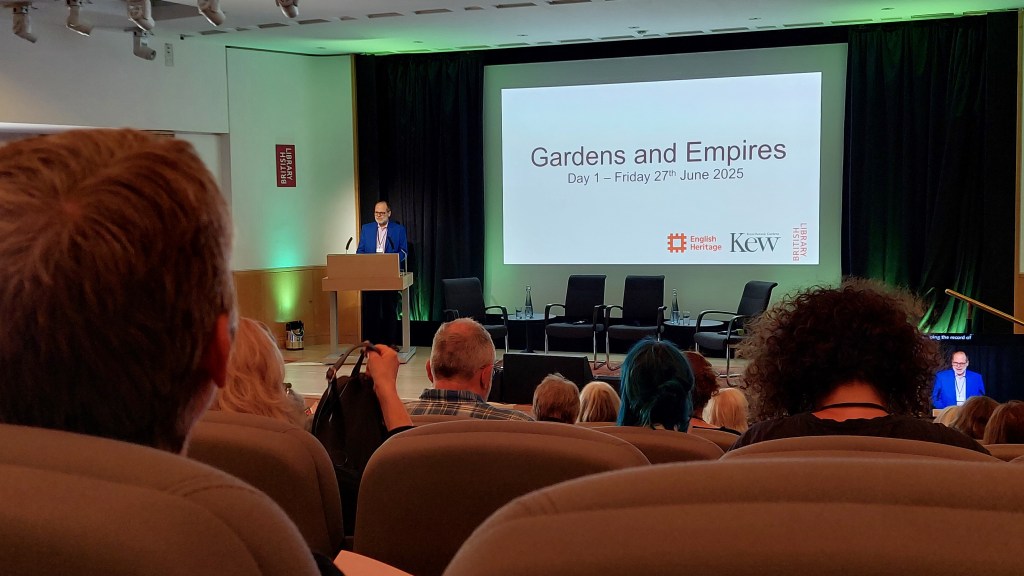
Over the course of two days, we attended sixteen talks that addressed various aspects of the relationship between landscape design, ornamental plants, imperial spaces, mobilities, identities, and the violence involved in the making of gardens. The opening keynote was delivered by Advolly Richmond, who explored the subtle entanglements between the development of the gardens at Warley Place and the arms trade, examining the role of Humphry Repton in Birmingham. Advolly’s talk was followed by the first session, which focused on gardens and landscape design in Asia. Tami Banh explored the connections between gardens and tombs as shaped by successive ruling powers in Vietnam. Jin Wen Chien then examined how Japanese colonial rule in Taiwan led to a radical transformation of its landscape and botanical richness. Additionally, a group of young scholars represented by Fei Mo and Minqian Zheng presented comparative research on how urban modernisation in Shanghai, Hong Kong and Singapore produced green spaces with distinct characteristics in each city.
The second session turned to the British Empire and its relationship with gardens. Caroline Cornish examined the origins of the Victoria Memorial Gardens in Kolkata and the remarkable attempt to establish a temperate garden in this tropical Indian city. Emily Parker set plants aside to explore the use of Caribbean shells and corals in the creation of Italian-inspired grottoes in eighteenth-century English gardens. Kimberly Glassman then presented research on the contradictions surrounding so-called European ‘weeds’ as seen through the eyes of European settlers in North America during the eighteenth and nineteenth centuries.
The following session shifted away from the gravitational force of the British Empire to look at green spaces in other parts of the world. Speaking from the Netherlands, Renske Ek reflected on the possibilities of decolonising the Palace Het Loo in Apeldoorn. Her talk was followed by Francisco Javier Girón, who explored the search for temperate trees in the creation of the Prince’s Garden at Aranjuez, Spain, and the influence of Kew as a model for arboreta. Back in the UK, Joanna Marschner closed the day with a presentation on Princess Augusta of Saxe-Gotha and her role in the conception and development of Kew Gardens between 1750 and 1770.
For those attending in person, the conference also offered the chance to visit the Unearthed exhibition, which showcased the astonishing resources of the British Library. From Thomas Hill’s 1558 The Profitable Arte of Gardening, the first English gardening manual, to a digital pollinator’s-eye view of a meadow by Alexandra Daisy Ginsberg, the exhibition – running until 10 August – revealed how gardening practices are shaped by political and economic power, and how they in turn have the potential to change lives. Some attendees also gathered for drinks and snacks at the end of the first day in the gardens beside the library. This community-based garden, created on a bombing site from the Blitz, has become a hub for the local community. An allotment-like space filled with potatoes, sage, currants, tomatoes and many other edible, medicinal and aromatic plants, it serves as a living example of how plants bring people together.
The second day began with a session on People and Economics. Kate Teltscher explored the experiences of two young Black men from Lagos who travelled to Kew Gardens in the early twentieth century to train as gardeners, highlighting the successes, mismatches, and implicit racism they encountered. Next, using the gardens of Welbeck Abbey in Nottinghamshire as a case study, Suzanne Seymour discussed the relationship between pineapples, prestige and politics, revealing how this Amazonian fruit gained immense social status and drove innovations in its cultivation, including the invention of stove houses. Catherine Middleton closed the session with her work on the links between Scottish country house gardens and the profits of transatlantic slavery between 1707 and 1850.
I opened the next session, titled Plant Mobilities, presenting findings from my research on how contrasting perceptions of ornamental plants in England and the tropical Andes (Colombia and Ecuador) triggered a wave of plant exchange unseen since the Columbian Exchange of the sixteenth century. I was followed by Timothy Barnard, who told the history of the Singapore Botanic Gardens through three key plants – palms, rubber, and orchids – and their connections to Kew Gardens.
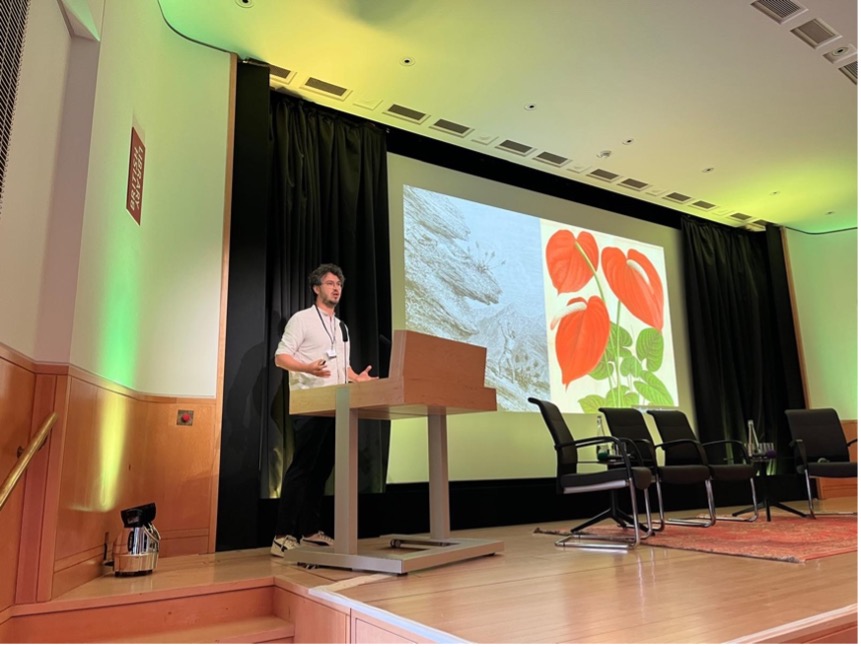
The second session of the day explored the legacies of empire and colonisation. Jill Sinclair discussed the violence embedded in the making of certain gardens, focusing on the ‘human zoos’ presented during King Leopold II’s International Exhibition in Belgium. This distressing history was followed by Lisa Williams’ discussion of how settlers in Western Australia transformed what they viewed as ‘wilderness’, reflecting on the ecological and cultural consequences of colonial landscaping.
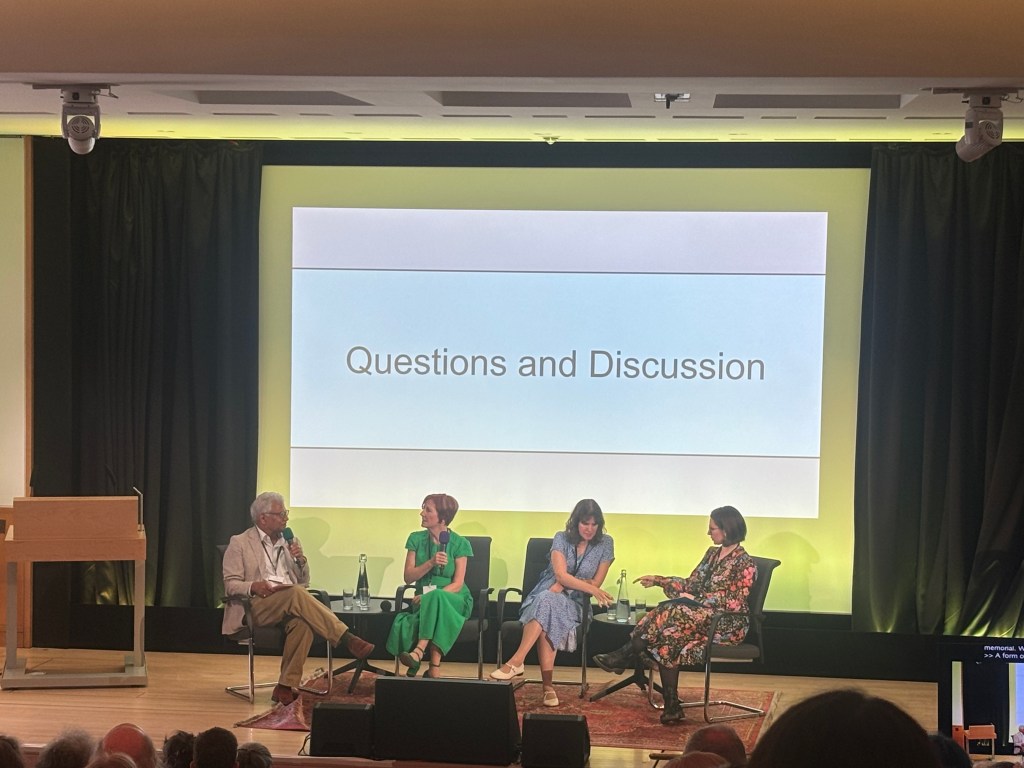
The conference concluded with a roundtable featuring Fiona Davison (Royal Horticultural Society), Akiko Tashiro (Hokkaido University) and Kwesia (City Girl in Nature / Global Generation). Moderated informally by author Sathnam Sanghera, the conversation touched on a range of topics including how to study the legacies of power in plant histories, how we cultivate plants today and how gardens can foster community.
Overall, the focus and diversity of the talks reflected the organisers’ intention to make the conference an open conversation that moved beyond strictly academic perspectives. In doing so, the event successfully brought together scholars, enthusiasts, and curious minds alike. However, as Advolly Richmond pointed out, the composition of the audience itself revealed how the exclusions inherent in empire-building still echo today. The conference made clear the urgent need to include alternative voices and perspectives to better understand gardens beyond Western and academic frameworks. This dialogue is a call to genuinely include marginal voices from diverse social backgrounds – recognising how their horticultural and gardening practices help us interpret both historical and ongoing forces of imperial homogenisation. In this regard, Kwesia, drawing from her own experience, offered a simple but powerful insight: instead of waiting for marginalised communities to knock on the doors of gardening institutions, these institutions must take the initiative to engage where these communities are actively using plants to shape their lived environments.
In addition to these reflections on inclusion and exclusion in garden histories, Judy Ling Wong from the Black Environment Network encouraged a more ethical and transparent approach to narrating the histories of dispossession, violence, and exclusion embedded in many gardens worldwide. This prompted several responses advocating for a reflexive, socially situated perspective – what postcolonial scholars call a ‘place of enunciation’ – through which researchers and enthusiasts interpret and share garden stories and their ties to power.
To conclude, I must highlight the impeccable organisation of the event, led by Emily Parker (English Heritage) and Caroline Cornish (Kew Gardens). The outstanding institutional and technical support from the British Library team not only provided an ideal venue but also enhanced the experience for both attendees and speakers
 whitehorsepress