In this blog, originally published as the ICEHO pages in Global Environment (June 2025), Alexandra Vlachos introduces the University of Bern’s Master’s programme in Sustainability Transformations: Shaping the change for desirable futures which seeks to open creative space for thoughtful experimentation fostering sustainability transformations.Vlachos concludes ‘We need solid and brave ideas to achieve a more sustainable future, and we need a generation of healthy, resilient and educated young people to create and implement their visions’.
As severe and complex challenges threaten the resilience of global ecosystems, many people acknowledge the forbidding suite of challenges that some have termed a global polycrisis.[1] Time for meaningful action seems to be running out and hopes for effective responses have been battered, as climate targets are missed, and recent European and US elections have returned governments and leaders not just doubtful of the need for better Earth-stewardship but openly dismissive of calls for more diverse, just and sustainable societies. Many young and educated people suffer ‘climate anxiety’, and feel overwhelmed by multiple ‘wicked problems – and the realisation that they have little political power to address their concerns. In the face of these grim, if not downright depressing, circumstances, educators, researchers and concerned citizens alike should surely seek means of securing more desirable futures.
In September 2024 the Centre for Development and Environment (CDE) in the University of Bern launched a Master’s programme in Sustainability Transformations: Shaping the change for desirable futures.[2] This was initiated in response to the ‘multiple crises such as global warming, biodiversity loss, dwindling resources, and increasing poverty’ that are now ‘stark realities’. Recognising these issues as consequences ‘of how wealthy countries have structured the global economy and societal systems’, the programme seeks to explore options for comprehensive and targeted change to enhance social, environmental and economic sustainability. As a core member of the CDE research stream ‘From Vision to Action’, I was tasked with developing and teaching a ‘Desirable Futures’ module in the new programme.
When the independent group of scientists appointed by the United Nations Secretary-General submitted their first Global Sustainable Development Report in 2019, they declared without equivocation, that ‘The future is now’.[3] I took this slogan to heart in designing the module, to ask whether current circumstances in any way resemble the future we want and need. Is our world a safer, more equal and more resilient place than it was ten years ago? Do we wish that our predecessors had acted differently, and left a more sustainable and livable legacy? If so, why? Did they lack knowledge, or ambition and vision? In response to such questions, and after much deliberation with colleagues, the new module – which enrolled its first cohort of students in autumn 2024 – seeks to open creative space for thoughtful experimentation fostering sustainability transformations. It also examines the pathways (towards the SDGs) laid out in the UN’s 2030 Agenda for Sustainable Development in 2015 and asks whether the world is on track to meet them.[4]
Students of sustainability differentiate system knowledge (what is), target knowledge (what we wish for) and implementation knowledge (how to get there).[5] The gap between what we wish for and our understanding of how we might get there is often a major obstacle to realising change. We address this by studying the process of visioning, and identifying sound criteria on which to develop effective ‘pathways for transformation’.[6] Our aim is to equip students with a methodological toolkit that allows them both to develop and implement ideas to produce more desirable futures.[7] In sum, this module emphasises and actualises the power of hope by encouraging students to think creatively and confidently about how best to meet the challenges involved in achieving a sustainable future.
The Sustainability Transformations programme aims to impart competencies and skills rather than to satisfy specific ‘learning outcomes’. Its modular structure means that individual courses often rely on other elements of the programme (so a methods seminar complements the visioning methods emphasised in the Desirable Futures module). Students are expected to spend 150 hours of work on this module.[8] They meet in class once a week for eleven weeks (a further two weeks are dedicated to reading specific literature and one to working on an essay). We begin with concepts and theories and turn to methods and group exercises before a four-week long seminar series. The module ends with an excursion and a wrap-up session.
Class-time and engagement with relevant literature helps students to identify and create science-based visions for sustainability. To do this, they must understand the different ways in which time and sustainability are conceived. Students are subsequently equipped with a methodological toolkit to assist them in the development of visions and to facilitate implementation of these in real-world scenarios. They are then asked to write an essay (based upon their disciplinary background, and the criteria and methods introduced in the module) describing a desirable, sustainable, future.
Term starts with an in-depth reflection on perceptions of time (such as ‘linear’ time, ‘circular’ time, ‘spiral’ time, modern physics’ ‘spacetime’ etc.) and concepts of sustainability, especially critiques of ‘mainstream/Western’ perceptions built on deeply rooted mentalities of economic growth and committed to a view of the nonhuman world as ‘natural resources’ or commodities for human consumption. Students are encouraged to reflect, critically, on these alternative perspectives on both time and sustainability. We also discuss the Indigenous critique of Western approaches to ‘sustainability’ and the notion of the ‘Anthropocene apocalypse’ as a future scenario for climate change and ecological breakdown (noting that some Indigenous peoples argue that the displacement and dispossession of colonisation was effectively dystopian in its massive reduction of biodiversity and repression of cultural practices).[9] From that perspective, ‘future-making’ in response to massive disruption and change is already familiar to many less privileged societies and economies.
A second emphasis of these early weeks is on narrative. Visioning requires reflection on terminology and the power (and form) of storytelling. We cannot observe or measure the future, but we can describe how it might be. Thus, the stories we tell about it, and the ways in which they are presented, matter. After these discussions, we turn to consider methods for scientific visioning with the help of a colleague who is an expert in back-casting. He describes his contribution as beingabout the ‘visioning process, quality criteria for developing sustainability visions and the back casting approach. As part of the normative scenario approach, back casting starts from a desired future state or vision and works backwards to understand how that desirable future state can be reached’.[10] This input encourages students to develop their own sustainability visions and strategies to fulfil them.
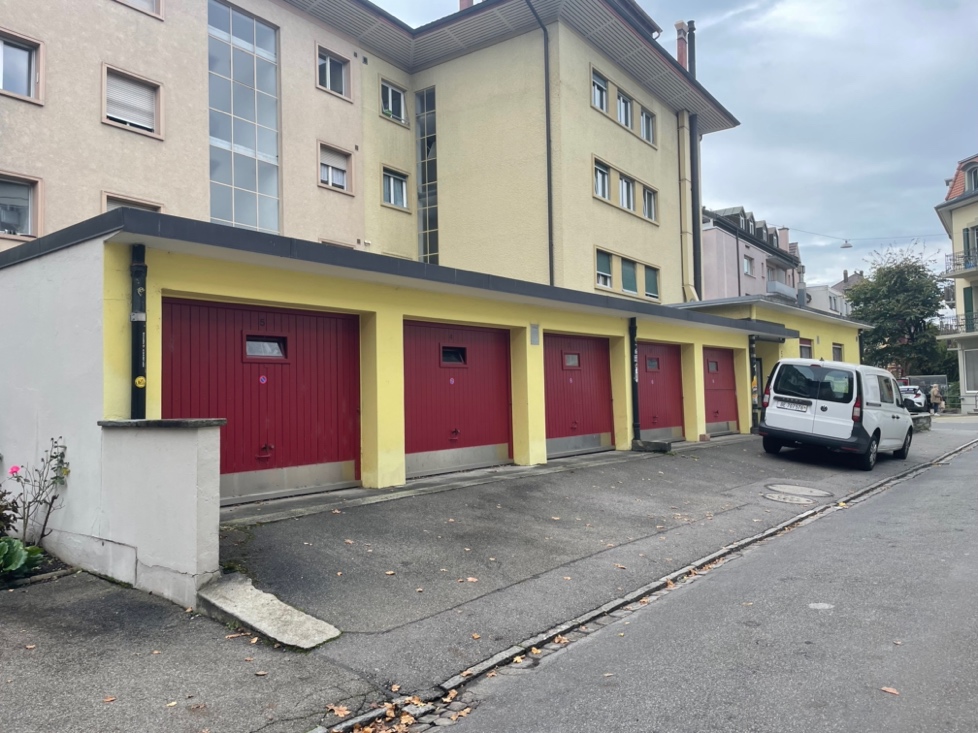
Then we move to practical work in visioning. In October, students are assigned to explore the University neighbourhood in two groups, each of which is required to identify two places as candidates either to remain the same or to be transformed by 2060. They have to take pictures of those places, develop arguments explaining why they think they should be changed, or not – and describe pathways for their possible transformation. These case studies are presented to the other group at the end of the term. See Figures 1 and 2.

November is given to a seminar series, in which three senior researchers from CDE and I present facets of our own research. This introduces students to ‘practical’ visioning through completed and ongoing research projects. The first session encouraged students to reflect on how to design visioning processes that promote both individual and collective actions toward desirable futures, by connecting the concept of visioning with insights from practice theory and innovation studies and situating it within the broader context of practice and socio-technical changes. The process was exemplified by reference to transition management efforts to support an area of the Swiss Alps on its path towards climate neutrality.[11]
The second session introduced a collaborative method of sustainable land management that understands landscapes as socio-ecological systems. Participatory visioning processes in landscape management were presented through a case study from Cambodia. Small scale farmers designed plans to develop more climate-resilient farms through integrated farming systems. The research and implementation project included education related to sustainable land management and integrated farming systems (through farm diversification), and collaborative decision-support methods.[12]
A third session pondered how Switzerland could regulate agricultural trade more sustainably. Achieving more effective and just trade rules require recognition that the food systems of the global North and the global South are interdependent, and that policy decisions are important levers for the implementation of a sustainability transition in global agricultural trade. Introducing a proposal for ‘A Federal Act on Sustainable Trade in Agriculture’ and arguing that a collaborative approach is needed in making our globally interconnected food systems more sustainable, this seminar indicated how domestic governments could distinguish between agricultural products particularly valuable for sustainable development and agricultural products particularly harmful for sustainable development without violating basic principles of the international trade framework.[13]
The final seminar session showcased the transformation of a ‘future going wrong’ into a more desirable future by the Indigenous peoples of Haida Gwaii (former Queen Charlotte Islands) in Canada in the late twentieth Century. It focused on the Haida’s active and ongoing role in visioning and implementing a more sustainable future for their territories, resulting recently in the Province of British Columbia formally acknowledging Haida Aboriginal Title.[14] This example of community and identity building, and of Indigenous people pushing back against colonial structures, offered a positive example of active future making.[15]
The seminars were followed by an excursion to ‘The Heitere Fahne’, an inclusive cultural venue in Wabern near Bern.[16] Theatre performances (and open theatre ateliers), concerts, artistic events, festivals, weddings, conferences and birthday parties are held at ‘The Heitere Fahne’ thanks to the dedicated work of a diverse team of around forty people and numerous volunteers from different backgrounds. As a ‘nowtopia’, the ‘Heitere Fahne’ is guided by a powerful visioning question: ‘How do we want to have lived?’ and tries to translate this into practice. With more than ten years of experience in implementing visions of desirable futures, ‘The Heitere Fahne’ team brought a practical perspective to the course. Students had lunch with the staff, engaged in the open theatre ateliers and engaged in discussions of funding and management with members of ‘The Heitere Fahne’.
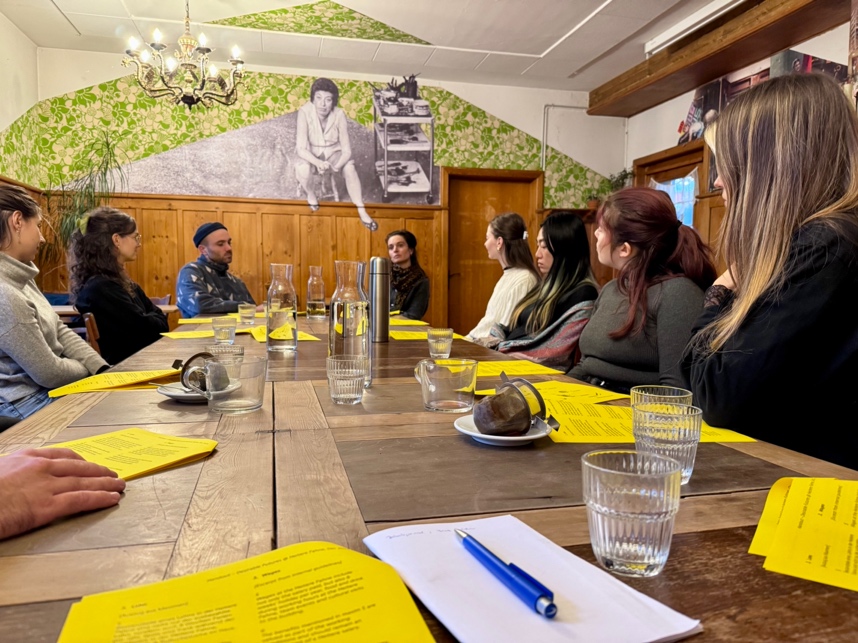
Term ended with students presenting the photographs and recommendations developed from their October case studies and with engaged and engaging discussions of our shared experiences in developing visions for sustainability transformations. In retrospect we agreed that this module had opened space for creativity and fostered optimism and collaboration. There was a lot of constructive discussion as our rather diverse group (of students and lecturers with different academic backgrounds, ages and at various career stages) came together to debate desirable futures – and ways of achieving them.
Our aim here was never to present turnkey visions, but to equip students with a solid toolkit and some real-world examples of how to vision for a sustainable future and find pathways for transformation. Visioning is more than a utopian game or a pastime for the Western elite. It is a driver for change. Encouraging students to be hopeful and visionary about the future also brought reward. To some extent, anger, protest and anxiety are necessary to drive change. But if we despair in the face of multiple challenges, neither great visions nor their effective realisation will be well served. We need solid and brave ideas to achieve a more sustainable future, and we need a generation of healthy, resilient and educated young people to create and implement their visions.
ACKNOWLEDGEMENTS
I am deeply grateful to Graeme Wynn for inviting, and then helping me to write, this essay. I thank my teaching assistant Nicolà Bezzola for his great work through the term, and for editing and commenting here. My colleagues Elisabeth Bürgi Bonanomi, Mert Duygan, Isabelle Porter and Susanne Wymann von Dach have contributed substantially by co-teaching methods and the seminar sections of the module. A heartfelt thanks to the first cohort of students, who all engaged in valuable and inspiring discussions, and made this journey worthwhile.
Alexandra Vlachos is an environmental historian focusing on Indigenous land management, settler-Indigenous relations, natural resource conflicts and ideas of sustainability with a geographical focus on Canada, Australia and Switzerland. She is particularly interested in how remote communities manage to create shared local identities and visions to sustain themselves in the face of the polycrises shaping the Anthropocene. She teaches at the Centre for Development and Environment (CDE) at the University of Bern.
[1] M. Lawrence, T. Homer-Dixon, S. Janzwood, J. Rockstöm, O. Renn and J. F. Donges, ‘Global polycrisis: The causal mechanisms of crisis entanglement’, Global Sustainability 7 (2024): e6. https://doi.org/10.1017/sus.2024.1.
[2] https://www.cde.unibe.ch/studies/master_in_sustainability_transformations/index_eng.html
[3] Independent Group of Scientists appointed by the Secretary-General, Global Sustainable Development Report 2019: The Future is Now – Science for Achieving Sustainable Development, (United Nations, New York, 2019): https://sdgs.un.org/publications/future-now-science-achieving-sustainable-development-gsdr-2019-24576 (Accessed 28 Jan. 2025).
[4] UN General Assembly, Transforming our world: the 2030 Agenda for Sustainable Development, A/RES/70/1, 21 Oct. 2015: https://www.refworld.org/legal/resolution/unga/2015/en/111816 (accessed 29 Jan. 2025). Environmental historian Verena Winiwarter has addressed the neglect of legacies (long-term consequences of past interventions) in the SDG concepts: V. Winiwarter, ‘An environmental history perspective on the UN Agenda 2030 (‘Sustainable Development Goals’)’, Global Environment: A Journal of Transdisciplinary History 13 (3) (2020): 689–94. https://www.environmentandsociety.org/sites/default/files/key_docs/iceho-pages_copy_2.pdf.
[5] ‘Sustainability science’ is transparently normative.
[6] A. Wiek and D. Iwaniec, ‘Quality criteria for visions and visioning in sustainability science’, Sustainability Science 9 (2014): 497–512, https://doi.org/10.1007/s11625-013-0208-6. On the somewhat arbitrary use of the terms transformation and transition in sustainability research: K. Hölscher, J. M. Wittmayer and D. Loorbach, ‘Transition versus transformation: What’s the difference?’, Environmental Innovation and Societal Transitions 27 (2018): 1–3.
[7] The term ‘vision’ differs from scenario building or forecasting as it describes the process of visioning and is thus defined as a desirable state in the future: R. Constanza, ‘Visions of alternative (unpredictable) futures and their use in policy analysis’, Conservation Ecology 4 (2000): 5–22.
[8] 30 hours of attendance time, 40 hours of reading the mandatory literature, preparation and follow up during the semester and 60 hours of preparation for and completion of the assessment and 20 hours of following further readings and interests from the course.
[9] Kyle P. White, ‘Indigenous science (fiction) for the Anthropocene: Ancestral dystopias and fantasies of climate change crises’, Environment and Planning E: Nature and Space 1(1–2) (2018): 224–42.
[10] Contribution by Dr Mert Duygan (CDE).
[11]https://www.cde.unibe.ch/research/projects/local_energy_transition_experiments_for_a_low_carbon_society/index_eng.html. Presented by Susanne Wymann von Dach, Just Economies and Human Well-Being Impact Area.
[12]https://www.cde.unibe.ch/research/projects/climate_resilient_integrated_farming_systems_in_cambodia_and_laos/index_eng.html Presented by Dr Isabelle Providoli, Sustainable Land Systems Impact Area.
[13] E. Bürgi Bonanomi and J. Schäli (eds), Federal Act on Sustainable Trade in Agriculture? A Proposal for the Implementation of Art. 104a lit. d of the Swiss Federal Constitution (2024): https://boris.unibe.ch/192843/1/B_rgi-Bonanomi_Sch_li_2024_Federal_Act_on_Sustainable_Trade_in_Agriculture.pdf (accessed 28 Jan. 2025). Presented by Dr. iur. Elisabeth Bürgi Bonanomi, Head of Sustainability Governance Impact Area.
[14] British Columbia. Agreement on Haida Aboriginal Title: https://www2.gov.bc.ca/gov/content/environment/natural-resource-stewardship/consulting-with-first-nations/first-nations-negotiations/first-nations-a-z-listing/haida-nation-council-of/haida-title-agreement# and Haida Gwaii Reconciliation Act ([SBC 2010] https://www.bclaws.gov.bc.ca/civix/document/id/complete/statreg/10017_01 (acessed 28 Jan. 2025).
[15] J. Weiss, Shaping the Future on Haida Gwaii: Life Beyond Settler Colonialism (Vancouver: UBC Press, 2018). https://arcadia.ub.uni-muenchen.de/arcadia/article/view/121. Presented by Dr Alexandra Vlachos, Transformative Education and Science Impact Area.
[16] This was organised by teaching assistant Nicolà Bezzola.
 whitehorsepress