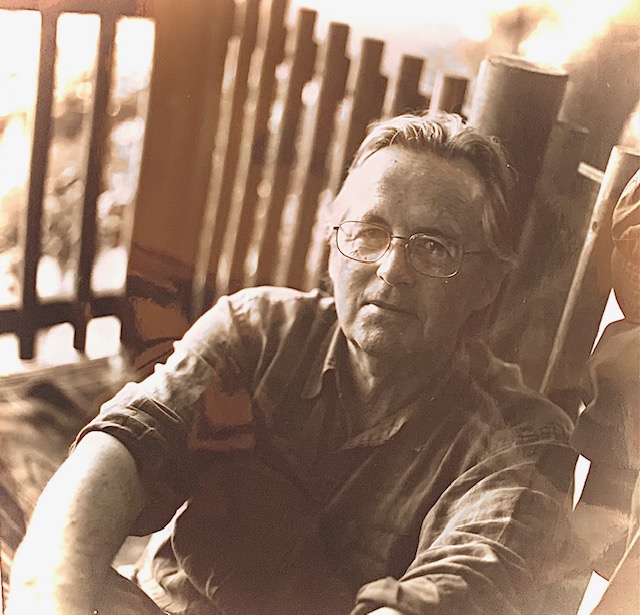
This blog post was published as part of a Special Section in tribute to Jeremy Swift in Nomadic Peoples 29.2 (September 2025) and offers a collection of personal tributes to this renowned anthropologist. You can read a previously unpublished research memoir by Jeremy and find a full bibliography of his works in the journal issue (all Open Access).
Personal Recollections
Jeremy liked telling a good story. One of them had him talking about his interest in birds with pioneer animal behaviourist Niko Tinbergen, and ending up with Tinbergen scribbling a minimalist research plan for him on the back of the conference leaflet. Jeremy was about ten.
He did eventually read zoology – and English – at Oxford, later joining IUCN (1962) and the FAO (1965), where he was responsible for the field programme in conservation. His lifelong interest in pastoralism began there, as he witnessed nomadic herders being evicted from newly created nature reserves, wrongly blamed for depleting wildlife and causing desertification. He later pursued a Ph.D. on the economy of pastoral Tuareg in Mali, and joined Sussex University in 1973, first at the Institute for the Study of International Organisation and, from 1978, at the Institute of Development Studies (IDS).
In a 1979 report for ILCA, Jeremy proposed to navigate the complex tangle of livelihood strategies of Niger Delta communities by identifying as ‘pastoralists’ those households deriving most of their income from livestock. The simplicity and economic framing of the suggestion – arriving just as neoliberal reforms were about to reshape development thinking –became one of the most used definitions of pastoralism worldwide.
Jeremy was a complex man. He loved grand plans but had a taste for understatement and never put himself first. He liked to joke that work should be fun, but took his tasks extremely seriously. He was a keen gardener and landscaper, while embracing the view that gardens should have no flowers. A solitary character, he was a charming converser and a natural mentor, with a deep respect for and interest in people. While he did not identify himself as an anthropologist, he used to say that ‘experts of pastoralism come in two types: those who spent at least one night in a mobile camp and the others’.
In 2013, the Commission on Nomadic Peoples of the International Union of Anthropological and Ethnological Sciences, presented Jeremy Swift with its Lifetime Achievement Award. He left his mark not only through research and writing, but also through his influence on public policy and the many people he encouraged and mentored along the way. I had the privilege of being one of them.
Jeremy took early retirement in his early 60s, when he was diagnosed with Parkinson’s. It had only been four years since I first knocked on his door at IDS, and about a year since he had begun to supervise my Ph.D. Supervision continued – usually as a blend of conversations and gardening over three-day sessions at his home in Wales. Now and again, Jeremy would begin, ‘Something often misunderstood about pastoralism is that…’. One of those misunderstandings – the importance of the period at the start of the rainy season, following months of dry heat – is the topic of the research note published in this issue.
This is only a glimpse. The personal recollections that follow take up the wider arc of his professional legacy.
Saverio Krätli
André Marty
Our friendship goes back to the 1970s, when Jeremy was on fieldwork for his Ph.D. in the Kidal region of Mali. He lived through the great drought and spoke so vividly of witnessing famine arrive. In the 1980s we found each other again in Rome, at IFAD, with three Interior Ministers during the organisation of the return of Malian and Nigerien refugees from Algeria (the second great drought). He always insisted it had to be a voluntary return. Ten years later, following a new Tuareg rebellion in Mali, he worked with Amnesty International and Human Rights Watch on the process of documenting the abuses committed against civilians.
Throughout the next decade, we shared concerns over the growing and multifaceted deterioration of the situation in Mali. In 2011, when a major crisis was widely anticipated, Jeremy contributed to the Special Programme for Peace, Security and Development in Northern Mali with Ibrahim ag Youssouf, a key figure in Mali’s peacebuilding efforts in the 1990s and a dear friend of Jeremy’s.
Shortly after, he collaborated with a IIED team including Saverio Krätli, Marie Monimart, Blamah Djalloh and Ced Hesse to evaluate the Pastoral Water Supply programs in Chad, work I had been contributing to for nearly two decades as part of IRAM.
Our companionship remained very Sahelian, very closely tied to Mali in particular. But Jeremy also worked in many other parts of the world, championing the future of nomadic pastoralists. And he did so through a dynamic, actor-oriented approach, at a time when, especially in France, studies tended to remain academic and disconnected from real development.
Angelo Maliki Bonfiglioli
In 1977, I was living in Niger with the Wodaabe pastoralists. One day – I still don’t know how – I was invited to participate in an international conference on African pastoralism in Zaria, northern Nigeria. After leaving a group of families who were daily struggling to find water and pasture at the beginning of their new transhumance season and travelling about 1,200 kilometres, I found myself among a group of renowned anthropologists, historians and linguists, who conversed together in intellectual jargon that was completely foreign to me. I was asked to present a short paper about my small project that, in the aftermath of the great drought of 1973, aimed to rebuild the herds of the poorest households using local solidarity and mutual aid mechanisms. The paper wasn’t as intellectual as it should have been for this kind of event and was not even included in the conference proceedings. Jeremy was the only person who showed empathy and great interest in my work. He even said that it was the best thing at the meeting! I can’t express what his attitude and encouragement meant to me, both personally and professionally.
Camilla Toulmin
It was a very hot day in Niono, central Mali, late April 1980. The kind of heat that pushes itself into every nook and cranny. Duncan Fulton and I were wilting in the thin line of shadow at the front of Niono’s case de passage, waiting for Jeremy Swift to arrive – we were meeting our boss for the first time: a mythical figure known for fleeting visits and decisive action. At last, a distant cloud of dust presaged an approaching vehicle making its way up the rutted track between the irrigation dykes. And finally, he was there! Full of energy and charm, immaculate polo shirt and khaki slacks. He found us a quiet cool corner to sit and a source of cold beer, and we got to work on planning and mapping our research project. He’d somehow secured a jeep for us to use, a source of cash to employ three research assistants, a trunk-load of questionnaires to fill in, and introductions to the Catholic priests who had made Niono their home and knew the wider landscape for miles around. His brother-in-law Richard Moorehead was soon to arrive and, together, we’d set off exploring to the west of Niono to find a village or two who’d be willing to host us for a two-year research project, initially – but which has now turned into a longitudinal study of more than forty years.
Jeremy made it all easy, exciting; we were part of a team with big ambitions to map and analyse the mosaic of livestock and cropping systems across the West African Sahel. Sara Randall, Ced Hesse, Duncan Fulton, Adam Thiam, Cindy White, Mike Winter, Mary Martin – it was a great team – with many of whom I am still in touch today.
Jeremy was much admired by the people we were studying. They could recognise a grand chef, and were always hoping he would stay longer than his brief visits to spend time with this source of power and influence. The villagers in Dlonguebougou were particularly happy when he somehow organised a small plane to come and buzz the village, making several passes over the settlement before throwing a plastic bottle containing a message down to the ground. A hundred children raced to go and pick it up – the message said ‘come and meet me in Niono’ – so off we went. These were the tricks one needed before the world of mobile phones. For years after, small model planes were fixed on long poles around the village, in a cargo cultish appeal for the plane to return.
After the two years in Mali, Jeremy and I worked on a review of evidence on the delivery of health and education services for nomadic people, drawing heavily on his time in Iran which had shown how an imaginative government could support rather than hinder the mobility of livestock-keeping people. Then, having joined IIED to set up the Drylands Programme, I relied on Jeremy for his insights and arguments in a common struggle against UNEP’s promotion of the desertification concept. He saw – rightly – the persistent and pernicious arguments used about ‘desert advance’ as a means by which governments, experts, donor agencies and some NGOs have tried to seize control of vast areas of land, dismissing local land users as victims of their own ignorance, and in need of settlement, to stop them wandering about aimlessly. Jeremy’s chapter in Melissa Leach and Robin Mearns’ book – The Lie of the Land – is a master-class in marshalling evidence and argument, to demolish the simplistic idea of desert advance. He was joined in this deconstruction of desertification by the likes of Mike Mortimore, Tor Benjaminsen, Stephen Sandford, Ian Scoones and Saverio Krätli.
We had further occasions to collaborate, such as the Sustainable Livelihoods project led by IDS, which enabled Karen Brock to live in DBG for eighteen months in the late 1990s, a fascinating exercise in following what had happened in the more than fifteen years since Duncan and I had left the village. It also then gave me a valuable staging post for my own return study in 2016–17. Our planning of the Sustainable Livelihoods Programme took place at the Pant, and I am sure that much of the energy and creativity it generated was a consequence of the time we spent in that magic valley, sharing ideas and spending time together.
Since Jeremy retired, we have been lucky to go and stay with him and Camilla many times. We’ve seized the opportunity to go for long walks through the hills, enjoying the shepherding country with its rough upland grazing, and green narrow valleys, before returning to the calm of his home, the formal gardens, and tended woodlands beyond. Jeremy brought together the most important elements in a life well-lived – intellect, warmth, engagement, loyalty and enjoyment of the magical setting which he and Camilla created.
Ced Hesse
I first met Jeremy Swift in 1981, when he hired me to join a team of young researchers affiliated with International Livestock Centre for Africa (now ILRI). We were tasked with studying Bambara farming and Fulani pastoral systems in central and northern Mali, as part of a broader research programme on pastoral and dryland farming household economic dynamics in the Sahel. Jeremy’s research vision stood in stark contrast to the prevailing ILCA agenda at the time, which largely promoted more sedentary, input-intensive livestock systems. Jeremy was committed to understanding and demonstrating the internal logic, resilience, and interdependence of family farming and mobile pastoral systems. He saw value where others saw disorder, and complexity where others saw chaos. That opportunity – and Jeremy’s mentorship – were instrumental in shaping the trajectory of my career. It marked the beginning of a lifelong engagement with pastoralism and set me on a path I’ve followed ever since. For that, I will always be deeply grateful. I was far from alone. Over the years, Jeremy mentored and inspired a whole generation of researchers and practitioners, building a critical mass of people committed to working with, not against, the grain of pastoral systems. His influence helped ensure a continuity of serious work on pastoralism not only in the Sahel, but across East Africa and into Asia. His legacy lives on in the many of us who continue that work today.
Jeremy never gave up on pastoralism, even when many others did. In the wake of the devastating droughts and famines of 1973 and 1983–84, pastoralism was widely written off by policymakers as outdated and unsustainable. Jeremy resisted that narrative fiercely. He remained steadfast in his commitment to keeping pastoralism on both the research and policy agenda, and to challenging the often-misguided assumptions that painted mobile livestock systems as environmentally destructive or economically irrational. Alongside others – many of whom had, like me, been mentored by him – we worked to tell a different story, a story grounded in lived experience and solid empirical evidence. Together, we helped reframe pastoralism as modern and mobile: an intelligent, adaptive strategy that works with nature, sustains livelihoods, and contributes meaningfully to local, national and regional economies; not a relic of the past, but a vital system with a future. Jeremy’s impact wasn’t confined to academic circles. In Kenya, for example, he played a key role in shaping the country’s drought early warning system for the arid and semi-arid lands. Drawing on his deep understanding – and that of others – he ensured that the system’s indicators genuinely reflected the realities of pastoral production. It was one of many examples of how his work translated into practical tools that made a real difference on the ground. Jeremy was a pioneering thinker and a tireless advocate for pastoralist communities. I will miss his sharp mind, his dry wit and, most of all, his unwavering belief in the value of our work.
Brigitte Thébaud
At the end of my research among the Fulani of eastern Niger, I was told: ‘Go see Jeremy Swift, he’s a great scholar of pastoralism’. In 1985, I knocked on his door, soaked by the London rain… A marvel, after 18 months of drought in the bush! The man who opened the door was indeed tall and quite magnificent. I smiled at that, but what struck me most was his intelligence and generosity. He handed me towels to dry off and asked about my plans. I told him I intended to begin my study with a portrait of the family I had lived with. ‘Perfect – he said – I’m leaving for Mongolia tonight. Settle in, work, and I’ll read what you’ve written when I return.’ He left me with a fridge full of food and a typewriter. Ten days later, he returned and, without delay, sat down to read my work in silence. I was petrified. After an hour, Jeremy handed my text back to me, the margins full of ‘PM’ notes… Seeing my confusion, he laughed and explained: ‘PM means Paris-Match. Your portrait is interesting, but it’s too much like a tabloid! You’re a researcher, not a journalist. So, back to work!’ This lesson in rigour marked me for life — and was the beginning of a long friendship.
Ian Scoones
I first met Jeremy in the mid-1980s while I was doing my Ph.D. I was clear I didn’t want to be a fisheries biologist like those in my ‘lab’ at Imperial. His work sounded much more interesting. My Ph.D. gradually morphed from livestock population biology to something more akin to economic anthropology, and Jeremy ended up as the external examiner in 1990. He liked the thesis, except that I had misspelled ‘veterinary’ throughout (never again – each mistake had to be tippexed over and rewritten). By that time, I was already working at IIED with the Drylands Programme led by Camilla Toulmin. In 1988, my first task was to compile a bibliography on ‘sustainable pastoralism in Africa’, and Jeremy was extremely helpful with references. A few years later, I was Jeremy’s colleague at IDS as part of the nascent Environment Group. Fast forward to 2019, and I was still engaging with Jeremy, this time with a new generation of pastoralism-focused Ph.D. scholars – the PASTRES project student cohort working in six countries across three continents. Jeremy attended their ‘research outline’ presentations at IDS and a few weeks later we headed to Wales to visit him and Camilla. It was a wonderful couple of days. We discussed our favourite books on pastoralism in the garden (Jeremy chose Robert Netting’s Balancing on an Alp), visited Jeremy’s library (the students were in rapture) and began drafting a collective introduction to the 2020 IDS Bulletin archive issue on pastoralism, celebrating fifty years since Jeremy started his own Ph.D. We also spent time with Jeremy’s shepherd neighbours whose challenges as pastoralists in Wales seemed so familiar to all of us, wherever we were working. Pastoralism, sustainability, livelihoods are the keywords of Jeremy’s career, and they are of mine. I could not have had a better mentor over so many years.
Mohamed Elmi
Jeremy’s influence can be traced in every major development in Kenya’s approach to pastoralism since his time. He shaped the policy and institutional framework for drought and for peacebuilding and conflict management, both of which remain in place to this day. He challenged us to think more deeply about policy, and more imaginatively about nomadic education. We weren’t able to realise all his brilliant ideas. One of my favourites was his plan for a ‘Report on the Status of Pastoralism’ – essentially, national-level monitoring of the wellbeing of pastoralists, embedded in each country’s bureau of statistics, that would be aggregated at a regional or even global level. It would both strengthen understanding of pastoralism in each country and reinforce global advocacy, and it was one of countless examples of Jeremy’s inspired thinking. He was a constant source of encouragement to me and so many others, generously sharing his ideas and drawing on his astonishing network of connections to link us with other experts and with fellow pastoralists around the world.
Izzy Birch
In August 2007, Jeremy and Camilla opened their home to four pastoralists from Kenya and Mali, supported by two staff of SOS Sahel UK. Pastoralists have always lived with change, but Jeremy worried that they might now be facing a far more significant transformation in their circumstances. Could scenario planning, he wondered, help pastoralists manage complexity and uncertainty? Could they use it to articulate a vision of their preferred future on their own terms? For three days the group debated the questions and tested an approach, inspired by Jeremy’s enthusiasm and insights and by walks around his beloved garden. East and West Africa found common ground and made new alliances and resolutions in glorious Welsh woodland.
Robin Mearns
When I was appointed as an IDS Fellow in 1990, Jeremy invited me to join him in setting up a project to advise the Mongolian Government ‘in real time’ – based on empirical field research – on policy options as the post-Soviet pastoral economy decollectivised. We had unprecedented access at a critical historical moment, entirely thanks to Jeremy and his prior connections via the British Council. This became the Policy Alternatives for Livestock Development (PALD) project which run from 1991 to 1994: a MacArthur Foundation-funded collaborative research and training project between IDS Sussex and key Mongolian research institutions and collaborators including B. Erdenebaatar, A. Enkh-Amgalan and many others. A special issue of this journal in 1994, edited by Jeremy and me, provided an early synthesis of much of this research (Nomadic Peoples Vol. 33). PALD work helped shape Mongolia’s 1993 Land Law and so much else, including laying the analytical foundation for the World Bank-supported Sustainable Livelihoods Program (2001–2022) and Livestock Insurance Project (the first of its kind in the world), with many of the same Mongolian partners and leaders, by then in highly influential positions as advisors to Prime Ministers and the like. Jeremy was one of the most important mentors I have ever had, an incredibly important influence in my life and career, and someone I will always treasure as a dear friend.
Roy Behnke and Carol Kerven
Dear Jeremy,
Did you know that you transitioned from a Swift to a Fisher in 1993? In that year our daughter, then four going on five years old, had accompanied us to rural Mongolia to supervise field work on one of your projects. At that age the creatures in Beatrix Potter’s stories were for her perfectly alive. Upon observing a camping companion gnawing on a mutton bone she concluded that he was ‘just like Samuel Whiskers’, who was a rat.
In a more flattering vein, she had heard a lot about this Jeremy fellow who was important because he had arranged for us to go camping in Mongolia. He was also, it turned out, a fisherman. ‘The Tale of Mr Jeremy Fisher’ came immediately to her mind. Mr Swift was a person of unknown character. Jeremy Fisher, on the other hand, was a frog of distinction and exemplary character. He indulged in outdoor recreation and put aside temporary difficulties to entertain his friends at dinner.
Sometimes children can reduce complexity into something simple and true. Upon returning home, our daughter was asked by her preschool teacher what she ate in Mongolia. The menu was described as ‘Mutton for breakfast, mutton for lunch, mutton for supper, and potatoes on special occasions.’ Many an academic account of Mongolia in 1993 does not, in my opinion, capture the essence of the situation with such economy of expression.
And so it is with Mr Jeremy Fisher. It helps our family look back with affection on an important time and on an important person in our lives. Dr Swift, you may command the attention of Google Scholar, but in our household Jeremy Fisher reigns supreme.
María Fernandez Gimenez
Jeremy was a member of my dissertation committee and was the person who made my first trip to Mongolia in 1993 possible. I now appreciate even more his support and mentoring of me as a very inexperienced and young woman scholar trying to do really ambitious and complex interdisciplinary work. Unlike almost everyone else, he never suggested I couldn’t do it or shouldn’t try.
Saverio Krätli
My particular brand of luck was to meet Jeremy late in his professional life, when he was able to be more generous with his time. I was eager to work on pastoralism, but I had a background in philosophy, no relevant work experience and unimpressive travels. From the very beginning, Jeremy let me into his world, hosted me in his home, shared his experience and his contacts, and conjured up professional opportunities for me.
Over the years, as he introduced me to his friends and the people he loved, Jeremy enjoyed telling a story of how I had persistently visited his office for weeks, asking him to supervise my MA dissertation, until he felt he could no longer send me away. Every time the story was a bit different but always beautifully crafted. Eventually, I started to believe it myself.
I do remember the first planning meeting. I said something like ‘I definitely want to work on pastoralism, but as to the precise topic for the thesis, I am still very confused’. He smiled. Then he said ‘That is usually a good sign!’ Jeremy had a way of putting you at ease first – as a precondition to let the good thinking flow, but also out of sheer generosity and tact. I feel deeply grateful for our long friendship and for the friends he left me with.
Jeremy’s support shaped not only my path, but also how I came to understand the broader challenges surrounding pastoralism. Working on improving the understanding of pastoralism in development circles, or even some scientific circles, means paddling against the flow; or, with a drier metaphor, pushing a loaded cart up a slope. Even in the face of progress – and some progress should be acknowledged – you cannot take your hands off. You cannot stop pushing. Jeremy understood that and, in the course of his professional life, directed his efforts not only to moving the cart forward, but also to increasing the number of hands pushing it up. Today, after a supposed paradigm change in the theory of pastoral development, started more than twenty years ago, not many in the new generation of scholars and technicians have heard of it, and even fewer have followed its implications and put it into practice. Instead, the new narratives around climate change – including those used in rangeland-based carbon trade – are turning back the clock on knowledge about pastoralism. They revive, under new clothes, some of the colonial myths that scholars like Jeremy spent their lives debunking and replacing with better-grounded understanding. Once again, pastoralists’ competence is disqualified, now on the grounds that the environment is unprecedented, reinstating external expertise as indispensable while historical responsibilities are swept under the carpet of climate vulnerability and adaptation.
More than ever, we need hands on the cart.
 whitehorsepress