In this blog, Chris Halsted contextualises his new article in Environment and History(online first December 2025), ‘Germany’s Feral Rheas: Colonialism, Rewilding, and Deep History in the Schaalsee Biosphere Reserve’, an article he admits it made no sense for him to start writing but which became a ‘letter to the sublime and beautiful weirdness of the world we inhabit’.
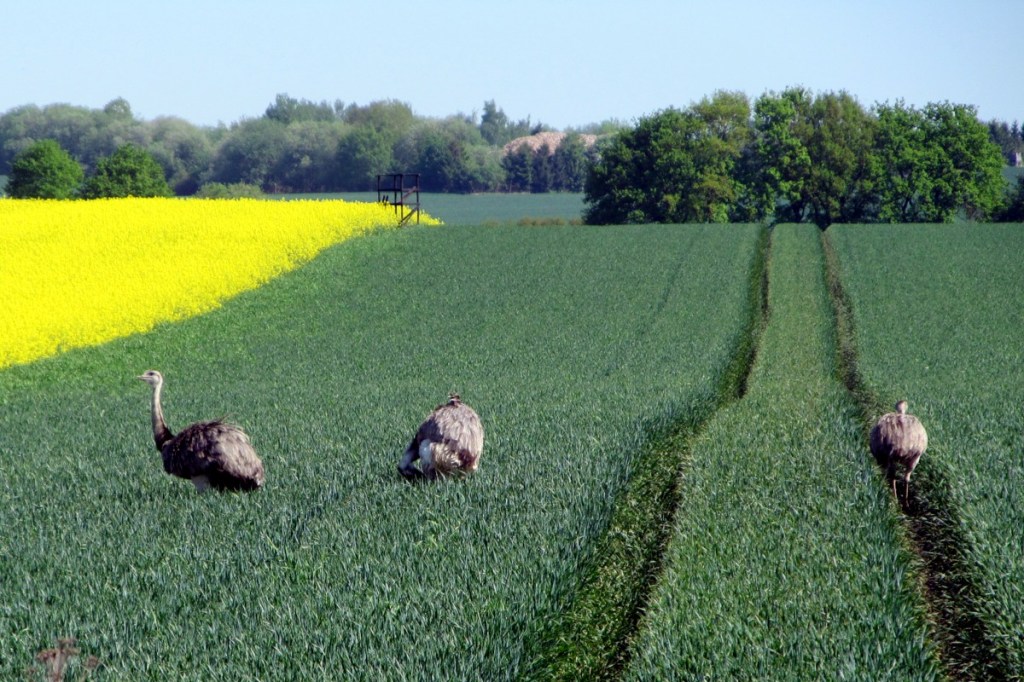
There are giant flightless birds stalking the forests of northern Germany, and they are hungry. This is not the plot summary of a D-list horror movie, but an actual description of a remarkable phenomenon shaping the environment south of the Baltic Sea. More than two decades ago, a group of greater rheas — large flightless birds native to South America — escaped from an enclosure near Lübeck and settled in the nearby UNESCO Schaalsee Biosphere Reserve. A nexus of German and international legal protections, along with the rewilded landscape of the biosphere reserve itself, facilitated the rapid establishment of a permanent population of rheas. By 2018, the estimated number of feral rheas in the region had risen to a high water mark of 566. My article in Environment and History looks at the phenomenon of the feral rheas from the perspective of landscape history and colonialism, interrogating the rheas’ story and the reaction to their success through the long-term history of the region and engaging with contemporary debates about concepts like rewilding and animal resistance.
This is not, in many ways, an article that it made sense for me to write. I am trained as a medieval historian, originally with a focus on the Slavic peoples of northeastern Germany and their interactions with global trade patterns during the Viking Age. I also, however, have a longstanding interest in zoos and conservation, especially regarding charismatic megafauna, and in addition I happen to have married into an Argentine family. Imagine my surprise when, a few years ago, I read an article in Audubon about a population of feral South American ratites that had established a permanent presence in northern Germany — the very landscape I had spent my graduate education studying. This, I thought, would certainly be an interesting thing for someone to look into — but as the story had nothing to do with the Middle Ages, that someone should probably not be me.
It will not shock anyone familiar with landscape history that I was utterly wrong. Landscapes are deep things, carved out over aeons through not only ecology but also human activity. I am writing this from the eastern coast of the United States of America, where the memory of the periods we call Antiquity and the Middle Ages often seems so distant as to be lost. This is the effect of hundreds of years of the erasure and destruction of Indigenous histories (the example of the Hopewell earthworks in Newark, Ohio being obliterated during the construction of the Ohio Canal comes to mind). In parts of the world not so severed from their pasts, the historical landscape is closer to the surface; human activity medieval, ancient or prehistoric moulds the contours of present land-use in much more evident ways (even if you sometimes have to do some digging to uncover that). The story of the German rheas, that is, had everything to do with the Middle Ages — I just had to look hard enough.
Indeed, the rheas’ story is deeply tied to the landscape in which they found themselves. The success of the population relied on the proximity of the Schaalsee biosphere reserve, a nature reserve formed from land on the inner German border that rewilded during the Cold War. And borders, like landscapes, tend to preserve long memories. My first round of digging led to the realisation that in this region the border between East and West Germany dated back, through various inheritances and recombinations of historical territories, to the Early Middle Ages, where it constituted the boundary of settlement between Germanic and Slavic peoples. This was a border that had somehow survived German colonial pushes in the High and Late Middle Ages, persisted through the various duchies of Mecklenburg and the rise and fall of the German empire, and left a mark on the landscape that remains to this day — the memory of a boundary that once stood between Christendom and paganism, between ‘civilization’ and ‘barbarism’. Now, at the dawn of the third millennium, it welcomes birds from the other side of the world, refugees of a very different form of Eurocolonialism.
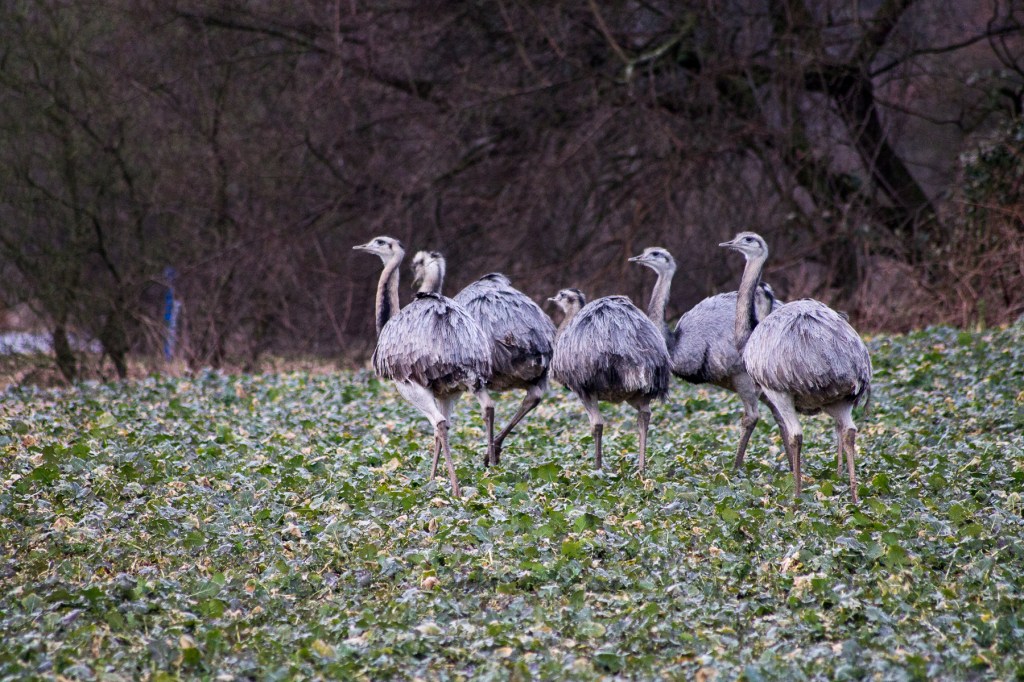
I was, of course, hooked, fixated on the fantastical image of an antipodean ratite wandering a landscape formed by medieval migration patterns and a border established by Charlemagne. I dove into research when I was supposed to be working on other things (a repeated habit of mine), finding myself devouring books on rewilding and articles on the history of Canola cultivation. My family and friends learned to tolerate an unending series of conservations filled with rhea facts. As my interest deepened, so too did my conviction that this was a story worth telling (and perhaps even worth telling by me): a story not only about how we categorise and understand wildlife, how we try to control and constrain the natural world as it rages against our efforts, but also a story about how landscapes and the ideas we have about them can link together seemingly disparate moments of history, from the manorial farms of the early modern Baltic to the pampas of Argentina.
My article is thus a letter to the sublime and beautiful weirdness of the world we inhabit, animal, human landscape, and all of the above. The story of the rheas took me from medieval Germany to the colonial world of the nineteenth century, when menageries, zoos and nature parks flourished as demonstrations of imperial powers’ claimed mastery over the Earth. That the resultant trade in so-called ‘exotic’ animals would eventually result in a flock of rheas finding shelter in a rewilded nature park, itself a landscape forged through the earliest stirrings of the colonial ethos later imposed upon the world, was to me a source of idiosyncratic irony. The consternation with which European societies, successors of the imperial metropole, have regarded such incidents of uncontrollable rewilding sits as an awkward consequence of the natural disruptions introduced by those same societies in the age of empire. As I largely restricted myself from bird puns in the body of the article proper, I will take this opportunity to say the following: such events, colonised megafauna running rampant in the fields and suburbs of Europe, may perhaps be considered cases of chickens coming home to roost.
REFERENCES
B. Carter and N. Charles, ‘Animals, agency, and resistance’, Journal for the Theory of Social Behavior 43 (3) (2013): 322–40.
R.-C. Collard, Animal Traffic: Lively Capital in the Global Exotic Pet Trade (Durham, NC: Duke University Press, 2020)
A. Crosby, Ecological Imperialism: The Biological Expansion of Europe, 900-1900 (Cambridge: Cambridge University Press, 1986, 2nd. ed 2004)
A. Eckert, West Germany and the Iron Curtain: Environment, Economy, and Culture in the Borderlands (Oxford: Oxford University Press, 2019)
S. Emory, ‘Inside Germany’s giant, hungry, flightless-bird problem’, Audubon, 26 Sept.2020: https://www.audubon.org/news/inside-germanys-giant-hungry-flightless-bird-problem(accessed 14 May 2024).
E. von Essen and M. Allen, ‘Wild, but not too-wild animals: Challenging Goldilocks standards in rewilding’, Between the Species 19 (1) (2016): 81–108.
M. Hardt, ‘The Limes Saxoniae as part of the Eastern borderland’, in F. Curta (ed.), Borders, Barriers, and Ethnogenesis: Frontiers in Late Antiquity and the Middle Ages (Leiden: Brill, 2006), pp. 35–49.
A. Korthals, O. Krone, J. Battermann, N. Jokisch, C. Grützmacher and F. Philipp, ‘Der Nandu — eine neue Problemart?’ paper presented at the Bildungszentrum für Natur, Umwelt und ländliche Räume des Landes Schleswig-Holstein, 2019.
L. Wolverton, ‘The Elbian region as predatory landscape, 900–1200 CE: Enslavement, slaughter, and settler colonialism’, Mediaevalia 43 (2022): 101–35.
 whitehorsepress