In this blog, originally published as a Snapshot in Environment and History (November 2025), Robert Piotrowski explores ‘the impact of economic, environmental and military crises (such as deforestation, war damage and inflation) on changes in the choice of building materials’ in the Plock Mazovian Region of Poland.
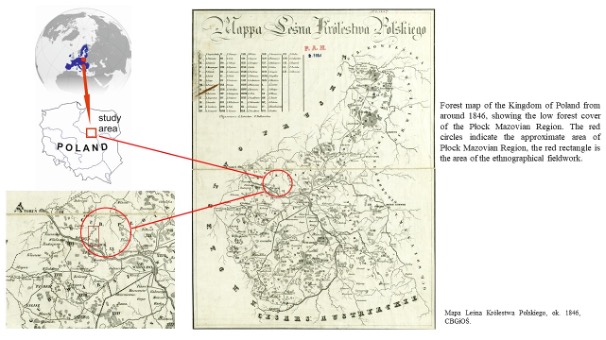
The Plock Mazovian Region is a historical-ethnographic region in central Poland between the Vistula, Skrwa and Wkra rivers (Figure 1). This essay argues that rural building practices in late nineteenth-century and twentieth-century central Poland offer a lens through which to examine the material consequences of socio-environmental crises. Despite the region’s low forest cover (around ten per cent) at the turn of the nineteenth and twentieth centuries, wooden architecture – particularly residential houses – remained dominant.[1] As a result, the persistent demand for timber, coupled with its limited availability, drove prices sharply upward. An 1876 issue of the regional newspaper Tygodnik Płocki reported: ‘The price of both construction and firewood has increased enormously over the last ten years in the Płock area … As for construction wood, there is no question at all – you cannot buy it anywhere in the region.’[2]
By the late nineteenth century, however, this scarcity prompted a shift toward alternative building materials, including clay, fieldstones and iron bog ore (see below). These materials, frequently referred to as ‘crisis materials’, became essential during times of necessity.[3] The use of ‘crisis materials’ in vernacular housing increased after 1918, following the end of the World War One. In the 1920s and 1930s, due to the economic crisis, many peasants living in the region built houses with materials ‘at hand’. Following another post-war crisis after 1945, houses were again constructed using clay and iron bog ore. Since the 1950s, the percentage of brick buildings has gradually increased.[4] As a result, masonry construction using brick and locally made concrete blocks gradually became more common, often supported by local cooperatives.[5]
Rural communities adapted their use of vernacular construction materials, such as clay, boulders and iron bog ore, demonstrating how local knowledge systems responded creatively to scarcity and ecological change.[6] Vernacular architecture in this context functions as a material archive of crisis-driven adaptation, revealing how rural communities navigated environmental and socio-economic disruptions through situated building practices.
Clay is a Building Material
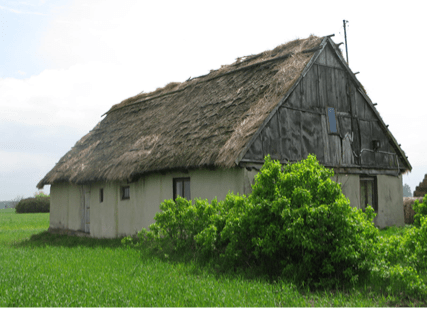
Clay was the first substitute material identified in the studied area. After World War One, wooden houses still dominated village architecture (59.5%), but clay buildings accounted for 18.7 per cent, making them the second most common type.[7] Though typically associated with the rural poor, clay construction was also used by descendants of German settlers who had arrived in Plock Mazovia Region during the periods of the Duchy of Warsaw and Kingdom of Poland (1807–1830)[8] (Figure 2). In many villages, the layout and design of these settlers’ houses – typically combining farm and living quarters under one roof – were widely imitated by the local, Polish population. It is likely that this influence extended not only to spatial organisation but also to the choice of building materials.[9]
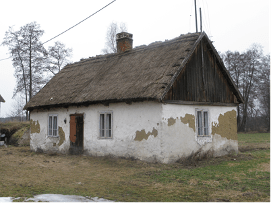
Most clay houses in the region were constructed either shortly after World War One or post World War Two. This trend corresponded closely with the economic and financial crises of the respective post-war periods (Figure 3). The extraction of clay for construction caused micro-transformations in the abiotic environment. For examples during the ethnographical fieldwork, several clay extraction sites were identified. In one instance, an abandoned clay pit was repurposed as a domestic dump, its depression still visible today. Another pit, filled with groundwater, was converted into a fish pond (Figure 4). During the field research one interviewee remembered from her childhood a pit near a newly built house that filled with water every spring during the thaw and became a popular play area for her and other children.
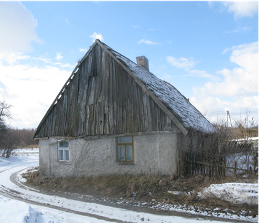
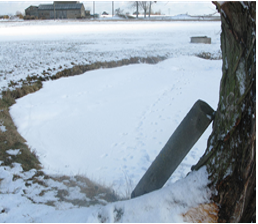
Figure 4. A post-German clay building purchased in the 1920s by a Polish family. The second photo shows the frozen fish pond at the clay extraction site (© R. Piotrowski).
The construction process involved mixing clay with straw, with proportions adjusted to the type of clay available. The mass was kneaded using horses or cows, although women and children occasionally assisted in tamping. Builders constructed the walls layer by layer, with the clay compacted within wooden formwork structures, a task primarily performed by women. Once hardened, the clay was left to dry. Building corners were reinforced with juniper branches or heather shoots placed between successive layers. Remnants of these techniques, such as visible plant materials and chaff in clay mortar, can still be observed in ruins of old structures (Figure 5).
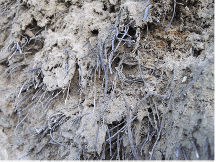
Figure 5. Clay walls with heather twigs – Września and Ostrów. Plant materials were used to reinforce clay structures (© R. Piotrowski).
Clay can thus be considered a ‘substitute building material’, particularly utilised during periods of economic, social or environmental crises and environmental changes, for example low forest cover.
Fieldstones as Crisis Materials
Erratic boulders, commonly known as ‘field stones,’ represent another crisis building material in the studied area. Transported from the Scandinavian region during the last glaciation, their widespread use in rural architecture began in the second half of the nineteenth century. Initially, these stones were used for fences and foundations in vernacular construction. However, as the demand for building materials grew and timber shortages persisted, fieldstones began to be used for agricultural buildings, such as barns, stables, and cellars. Some examples of stone granaries were also identified in the region (Figure 6).
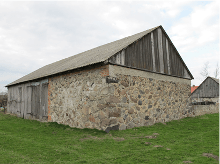
Figure 6. Stone barn in Dąbrówki and Wilków. Built in the late nineteenth century as timber became scarce (© R. Piotrowski).
Fieldstones were collected during spring agricultural work. Local beliefs and narratives described this process as ‘the earth gives birth to stones’, referring to the phenomenon of cryoturbation, in which cyclical freezing and thawing of the soil pushes stones to the surface.[10] These boulders, which hindered field cultivation, were removed and piled into heaps. Stones intended for construction were either used in their natural state or processed through masonry techniques, sometimes being broken into smaller pieces or shaped into cubes. For construction, they were joined or mortared with lime or clay-based mixtures.
Stone houses remain rare in the studied area, with only a few examples identified. The stone material was not used very often for the construction of residential buildings, not least because of the high level of complication in working erratic boulders.
Iron Bog Ore: A Unique Substitute
One of the most intriguing substitute materials in the studied area is iron bog ore. Its formation is closely tied to the biological environment, as high humidity fosters the development of iron bog ore deposits. These deposits are renewable and have been exploited for centuries to obtain iron.[11] Since at least the nineteenth century, however, farmers viewed iron bog ore as an obstacle to agriculture, often designating areas with deposits as wastelands. In one village, a farmer described removing iron bog ore from a meadow and piling it up to prepare the land for corn cultivation. While iron bog ore was used as a building material in earlier periods, its practical utility has since diminished.[12]
In this region it served primarily as a substitute material during crises when other building materials were unavailable.[13] Iron bog ore was utilised in constructing the walls of both residential and agricultural buildings. Field research identified several locations, particularly in the upper reaches of the Skrwa River, where iron bog ore deposits were extracted from fields and meadows near homesteads. Its shallow depth facilitated easy extraction.
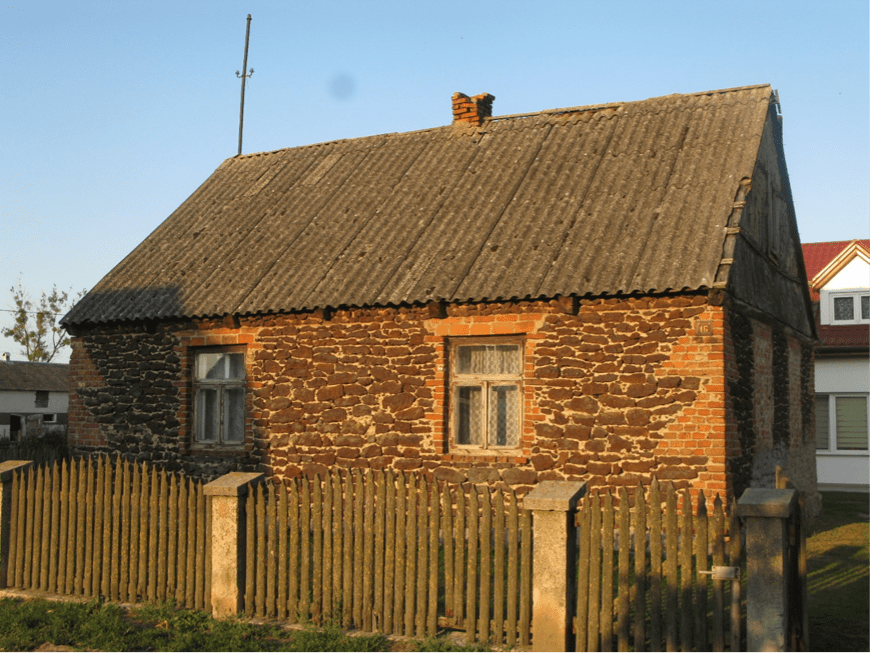
As a building material, iron bog ore possesses strength properties comparable to brick and is highly frost-resistant.[14] In the studied area, it was primarily used in rural construction after World War Two due to its accessibility. Respondents mentioned buildings made from iron bog ore located in border areas between Płock Mazovian Region and Ziemia Dobrzyńska.
In the village of Pietrzyk, several such structures were identified. According to local residents, the village primarily consisted of wooden buildings in the 1920s and 1930s, but after World War Two, both residential and agricultural structures were built from iron bog ore (Figure 7). Unfortunately, modern modifications, such as the addition of insulation, have obscured the original wall constructions.
Conclusion
The selection of alternative materials in the studied region was shaped not only by long-term deforestation but also by acute crises, primarily wars and economic disruptions, which forced changes in construction techniques. Yet, material choices remained deeply rooted in locally available environmental resources. Vernacular architecture in this region reflects not merely aesthetic or cultural tradition, but the community’s capacity to respond to crisis through practical and place-based material adaptation. These historical responses to scarcity highlight the resilience of local populations and offer valuable insights for contemporary approaches to sustainable and adaptive building.
ACKNOWLEDGEMENTS
I would like to thank Dariusz Brykała, Włodzimierz Juśkiewicz, Leona Watson, David Moon and Tyson A. Luneau for their pertinent and helpful comments.
Research was funded by National Science Centre (Poland), grant no. 2023/49/N/HS3/02181.
[1] S. Kozicki, Rolnictwo. In: Królestwo Polskie, (Warszawa: 1905), p. 265; G. Ciołek, ‘Wpływ środowiska geograficznego na formy osadnictwa i budownictwa wiejskiego w Polsce’, LUD 39 (1952): 245–46.
[2] Tygodnik Płocki 9 (21) (1876).
[3] M. Gładysz, ‘Budownictwo’, in Etnografia Polski. Przemiany kultury ludowej, vol. 1 (Wrocław-Warszawa-Kraków-Gdańsk: Ossolineum, 1976), p. 298; R. Reinfuss, ‘Z badań nad budownictwem ludowym w województwie kieleckim’, Polska Sztuka Ludowa 2 (1971): 69.
[4] M. Wesołowska, Rozwój budownictwa mieszkaniowego a przemiany przestrzenne wsi województwa lubelskiego (Warszawa, 2006), pp. 24-25.
[5] T. Czerwiński, Osadnictwo i budownictwo ludowe na Mazowszu północno-zachodnim w XIX i na początku XX wieku, (Sanok, 1995), p. 61.
[6] This study is based on ethnographic fieldwork conducted by the author in 152 localities across Płock Mazovian Region in 2010, 2017 and 2024. The data include 1,700 pictures and ethnographic interviews with building owners
[7] M. Kacprzak, Wieś płocka. Warunki bytowania (Warszawa: Instytut Spraw Społecznych, 1937), pp. 58–59.
[8] J. Święch, Architektura chłopska ziemi dobrzyńskiej od połowy XVIII wieku do lat czterdziestych XX wieku (Toruń: 2002), p. 158; P. Szkutnik, ‘Sprowadzanie użytecznych cudzoziemców. Osadnicy w zachodniej części Królestwa Polskiego w pierwszej połowie XIX w. na przykładzie przodków autora’, Kwartalnik Historii Kultury Materialnej 61 (3) (2013): 410; M. Milewska, ‘Koloniści niemieccy na Mazowszu u progu niepodległości II Rzeczypospolitej’, Rocznik SNPL 18 (2018): 67–86.
[9] R. Piotrowski, ‘Wpływ budownictwa ‘holenderskiego’ na formy budynków wznoszonych po 1945 roku w wybranych miejscowościach Mazowsza Płockiego’, Biuletyn Stowarzyszenia Muzeów na Wolnym Powietrzu w Polsce 13 (2021): 117–21.
[10] V. Wróblewska, ‘Kamień’, in Słownik polskiej bajki ludowej: https://bajka.umk.pl/slownik/lista-hasel/haslo/?id=74
[11] M. Thelemann, W. Bebermeier, P. Hoelzmann and E. Lenhardt, ‘Bog iron ore as a rescource for prehistoric iron production in Central Europe – A case study of the Widawa catchment area in eastern Silesia, Poland’, Catena 149 (1) (2016): 474–90; M. Leh, ‘Raseneisenerz-Vorkommen und das historische Hüttenwesen In der Görlitzer Heine/Puszcza Zgorzelecka’, Berichte der Naturforschenden Gesellschaft der Oberlausitz 27 (2019): 135–42.
[12] H. Sitschick, F. Ludwig, E. Wetzel, J. Luckert and T. Holding, ‘Raseneisenerz – auch in Brandenburg ein mineralischer Rohstoff mit bedutender wirtschaftlicher Vergangenheit’, Brandenburgische Geowissenschaftliche Beiträge 1 (2) (2005): 122–24; J. Skoczylas, ‘Wykorzystanie w przeszłości darniowych rud żelaza jako materiału budowlanego’, Ochrona Zabytków 53/2 (209) (2000): 206–09.
[13] R. Piotrowski, ‘Between necessity and pragmatism: Stone, clay and bog ore in rural architecture in the borderland of the Mazovian region and the Dobrzyń region’, Journal of Heritage Conservation 63 (2020): 145–46.
[14] J. Jasieńko, A. Di Tommaso, Ł. Bednarz, S. Casacci and K. Raszczuk, ‘Analiza porównawcza – wieże zagrożone zawaleniem w Polsce i we Włoszech: różne przyczyny, podobne problemy’, Wiadomości Konserwatorskie 43 (2015): 41.
 whitehorsepress