In today’s blog, Isis Brook, Deputy Editor of Plant Perspectives, reports on a very special plant humanities conference held in Palermo in May. Plant Perspectives is now open for submissions – this is your invitation to pass through the ‘portal to the plant realm’!
How wonderful to have a conference and summer school on philosophy and plants based in a botanic garden. The University of Palermo’s botanical garden was inaugurated on its present site in 1795 and is now ten hectares of a rich collection of plants from around the world.

The organisation of plants in the garden represents botanical systems during different historical periods. Thus there is an area laid out to demonstrate the Linnaean system, another the Engler system and, most recently, bio-ecological and geographic systems. The historic buildings in the garden also connected us to past botanical theorising and research with luminaries such as Theophrastus overseeing our examination of old specimen jars.

What strikes the visitor wandering through the gardens, particularly when the visit is over three days interspersed with presentations and discussions on the vegetal turn, is the presence of the plants themselves. Many of the discussions were held outside of the seminar room under the shade of palms.
Having so many plants ever-present helped to guide our thinking as we discussed presentations from the keynote speakers Paco Calvo and Michael Marder. Prof. Calvo walked us through many experiments conducted applying cognitive science to plants, emphasising that plant behaviour is open to the scientific method. We saw how the plant’s stationary habit, far from ensuring it was restricted in behavioural agility, actually meant it had to conduct complex information processing to respond to and thrive in its environment. Prof. Marder gave us an insight into his current thinking about time when he showed how we could reinterpret the nature of time through plants. There were other interesting contributions such as those from Thomas Heyd, Quentin Hiernaux, Rachel Peterson and Lucy Weir. And of course an excellent talk from Marcello de Paola who, along with Andrea La Moli, organised the event.
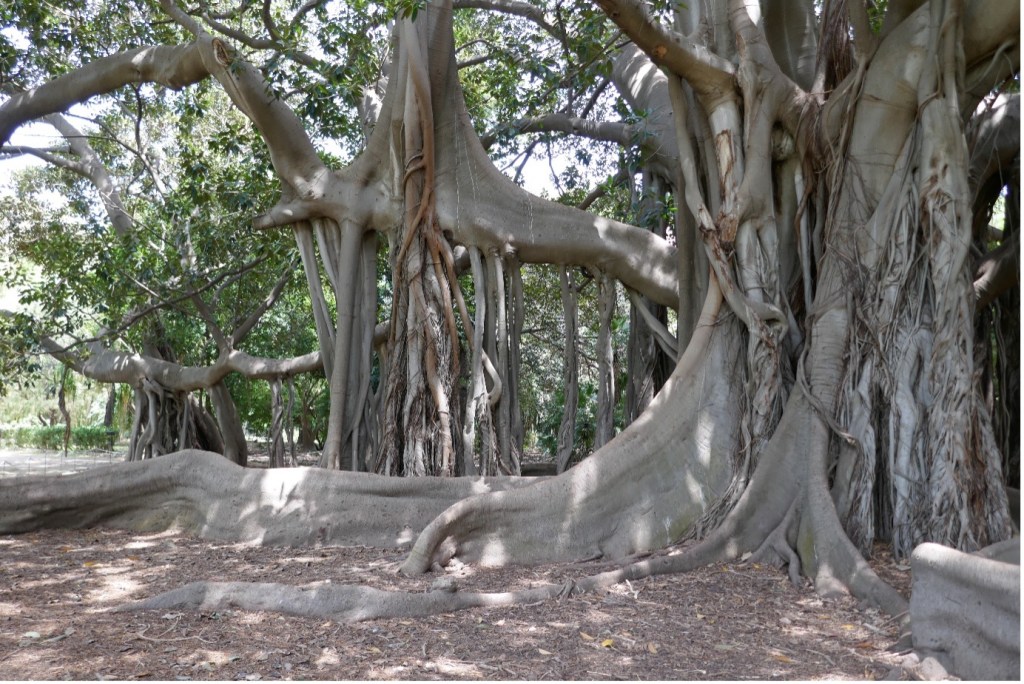
The experiences from the event that come back to me again and again are the plants. For example, the momentous Moreton Bay Fig (Ficus macrophylla f. columnaris). Introduced to the garden in 1845 it now has a crown of over 3,000 m2 and has to be controlled to prevent it becoming the only plant in the garden. This tree produced the many other specimens that can be seen taking over parks and gardens around Palermo.
The other plant that excited me, because I have read about it but never seen one, was the Welwitschia mirabilis. This is not what you would call a classically beautiful plant, but I just love a plant that defies easy classification such that it has to have its own genus. Welwitschia is a long-lived plant found in the Namib Desert of southwest Africa and has just two leaves, although they may split, but it retains these throughout its life supported by a long taproot. In the botanic garden they have several each in a tall pot in a large hothouse amongst the cacti.

The conference participants benefitted from a very informative tour of the garden as an orientation. This introduced us to the plants and also the historical stories and current issues of maintaining such a wonderful resource in the city. The stories included an explanation of what appeared to be a remnant of an old building in the grounds.
I will leave that for another time, suffice to say the guile involved had all the hallmarks of complex plant behaviour. I liked to think of this arch, and pass through it, as a portal to the plant realm.

 whitehorsepress