In this blog, Doubravka Olšáková introduces her new article in Environment and History, From Eradication to Adaptation: The Colorado Potato Beetle in Cold War Czechoslovakia (online first 23 October 2026).

In 1950s Cold War propaganda, the Colorado potato beetle took on a succession of sinister identities. It appeared as a Wall Street imperialist, a ruthless assassin or an enemy paratrooper. In Ondřej Sekora’s 1950 children’s book About the Wicked Potato Beetle, these invaders tumble from an aircraft, while the villain on the cover brandishes a knife and fork over a plate of potatoes. The subtitle made the threat explicit: the American beetle was coming to steal from our plates. For an insect interested in potato leaves, it was quite a political career.
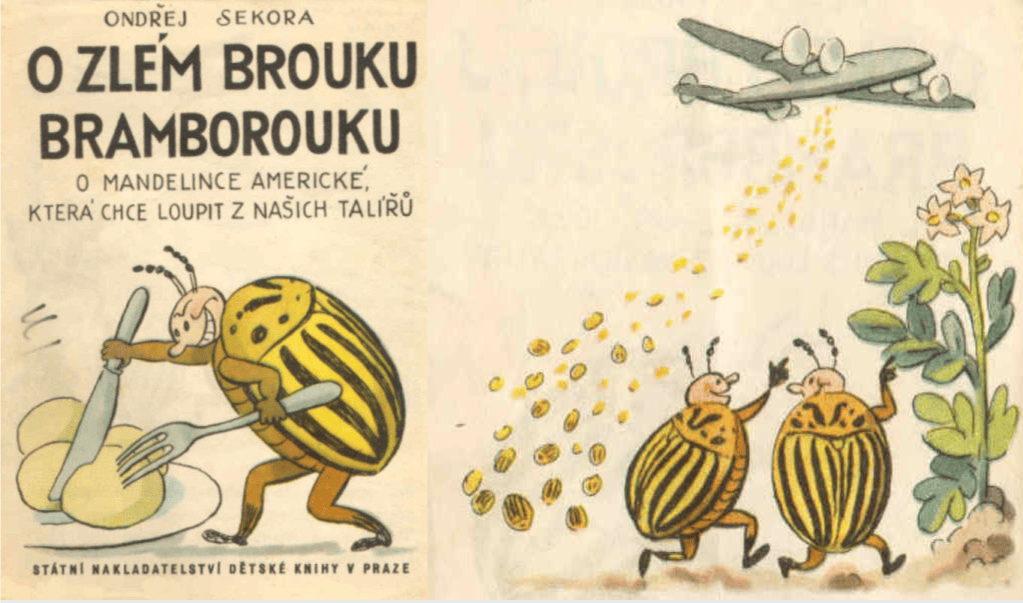
In the Soviet bloc, propaganda presented it as an agent of American sabotage. Its appearance supposedly revealed a Western plot to destroy socialist harvests and leave the population hungry. Even the vegetable patch had acquired a place on the geopolitical front line.
It is tempting to smile at the absurdity of an imperialist insect. But the beetles really were eating the crops and frustrating the authorities. In my article, From Eradication to Adaptation: The Colorado Potato Beetle in Cold War Czechoslovakia, I follow what happened when the promise of victory met an opponent that kept reproducing. I read this as a striking example of more-than-human resistance: without any political programme, the beetle frustrated the state’s ambitions and forced it to adapt. This reading draws on Timothy Mitchell’s Rule of Experts (2002), whose chapter ‘Can the Mosquito Speak?’ brings insects into the history of political power. Resistance, in this sense, could take the unassuming form of another generation of larvae. Behind the colourful propaganda lies a surprisingly practical question: how do you govern a pest that refuses to stay governed?
The beetle had embarked on its European journey long before the Cold War supplied it with a political identity. From a foothold in southwestern France in the 1920s, it gradually spread eastwards. By 1950, Czechoslovak officials were confronting an especially awkward problem: beetles kept appearing where they were not expected, including in fields that had supposedly been cleared. Each return exposed the distance between recording an infestation, declaring it eradicated and actually keeping the insect away. In official accounts, that gap increasingly filled with enemy aircraft scattering beetles along the border. The insect’s persistence became evidence of someone else’s intentions. In 1951, the minister of agriculture called for the involvement of the Ministry of National Security. A pest that would not stay governed had become a matter of both international and internal security.
The campaign against the beetle became a patriotic duty, carrying something of the discipline and obligation of compulsory military service. Orders went out for drums to be supplied to municipalities to summon the population, and workers and schoolchildren were mobilised to defend the harvest by searching the fields for beetles and their eggs. A report covering the 1950 campaign recorded the participation of 96,000 members of the Czechoslovak Youth Union. By 1951, children as young as seven could be assigned search duties, with younger pupils working for up to two hours a day. In this peculiar form of national service, one could be called up long before being old enough to wear a uniform.
The rhythm of this mobilisation was set by the beetle’s reproductive cycle. As eggs developed and new generations emerged, schoolchildren were mobilised for searches, while officials organised further interventions. The insect’s reproduction thus shaped the routines of school life and the schedules of agricultural administration, extending into the work of the security forces. One report recorded more than 1.6 million larvae collected during search operations: a measure of the enormous human effort organised around the biological rhythms of a small insect.
This is what I call the entomotemporality of the state: the subordination of administrative and institutional rhythms to the reproductive cycles of insect life. The beetle was indifferent to the ideological regime under which it lived. Its survival depended on suitable conditions for feeding and reproduction, yet the pursuit of that survival repeatedly set human institutions in motion. Without any intention of opposing communism, the beetle made parts of the state bureaucracy and its security apparatus work to its own reproductive timetable.
To regain the initiative, the state looked for allies among the beetle’s natural enemies. The enemy of my enemy is my friend – and so communism fell in love with the partridge. Birds previously hunted as game were now candidates for protection and organised breeding, while chemical treatments were already raising concerns about harm to bees. There was, however, a problem with this new friendship. The regime wanted more partridges to eat the beetles, but it also wanted bigger fields for mechanised collective farming. Creating those fields meant ploughing up the grassy margins where partridges nested; intensive chemical use also deprived their chicks of insect food. Both policies promised to increase agricultural production, yet one undermined the other. This was the blind spot in the ambition to remake nature through socialist planning: officials could recognise the bird’s usefulness while agricultural policy destroyed the conditions that made it useful. The partridge had been offered a job just as its home was being demolished.
There was something almost comforting about the beetle in Sekora’s illustrations. However sinister, it belonged to a recognisable political world: it had an enemy’s nationality and an enemy’s intentions. Behind its appetite stood American imperialism, giving the state a familiar explanation for an unfamiliar predicament. The living insect was harder to accommodate. Its reproduction required no foreign instructions, and its effects reached well beyond the potato crop.
Those effects give more-than-human resistance its historical substance. School routines and administrative work came to depend on when another generation appeared. The state’s formidable capacity to mobilise people became a means through which the insect’s life cycle organised human time. Accusing the beetle of sabotage preserved the idea that someone, somewhere, must be directing events. The more unsettling possibility was that a creature with no interest in governing anybody had nevertheless acquired a say in how the country was governed.

