In this blog Santiago Gorostiza, Alejandro Pérez-Olivares, Daniel Oviedo Silva and José María Sánchez Laforet synthesise the contribution of their recent Open Access article in Environment and History (online first May 2025), The Long Shadow of the Pines: Vegetation in the Birth, Destruction and Reconstruction of Madrid’s University City (1927–1956).
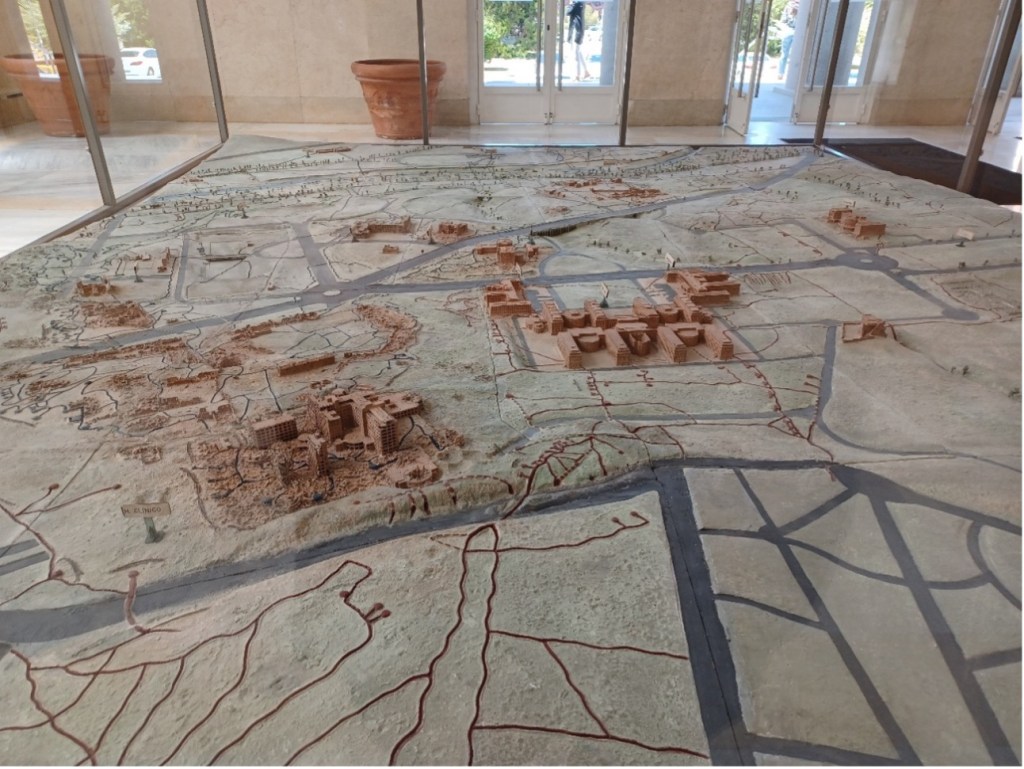
Upon entering the hall of the Faculty of Medicine at the Universidad Complutense de Madrid, two massive models greet the visitor. Both reproduce the campus of the Ciudad Universitaria, yet they depict radically different landscapes. To the right, the campus appears as a battlefield: a devastated terrain, criss-crossed by trenches, its faculties reduced to ruins and its grounds stripped of trees. The Ciudad Universitaria, still under construction when the Spanish Civil War erupted in July 1936, became the stage for one of the most iconic battles of the war. In November 1936, advancing from the west, the insurgent troops of General Francisco Franco crossed the Manzanares River and occupied part of the campus, reaching the edge of central Madrid. Fierce fighting followed inside the university buildings, with lecture halls and corridors transformed into defensive positions. The war split the campus in two, with Republican and insurgent troops occupying buildings only metres apart. Republican forces —including recently arrived volunteers from the International Brigades— managed to halt the offensive, and the university front remained largely frozen until the end of the war in 1939. The model reproduces the devastated campus left by three years of combat, with the positions of the opposing armies marked in blue and red.
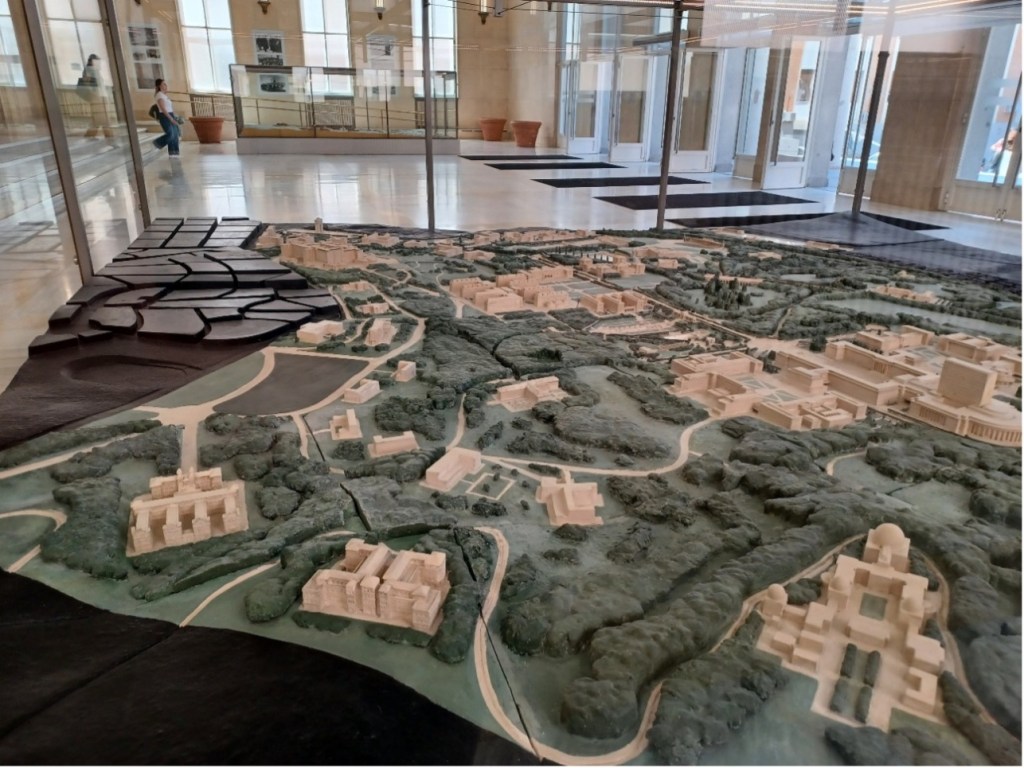
To the left, the visitor encounters a very different landscape: abundant trees, resembling true forests, surround dozens of buildings, with dark green tones predominating. Presented to Franco during the reinauguration of the Ciudad Universitaria, on 12 October 1943, the model portrays the planned reconstruction of the campus. Some of the most spectacular buildings represented were ultimately never built, while many other absent were eventually constructed. Over the last four decades, numerous studies have examined the reconstruction of the campus and its architecture in the context of the political history of the Francoist dictatorship[1] But very few have paid attention to the greenery surrounding those buildings and the reforestation efforts that produced it and sustained it. Rather than simply serving as decorative elements of the new campus, trees, gardens and wooded areas were central components of the symbolic and material reconstruction of post-war Madrid.
In our recent article, we examine how the greening of the Ciudad Universitaria became part of the Franco regime’s broader discourse of national rebirth and material reconstruction. The extensive reforestation campaigns that reshaped the campus formed an integral part of its post-war transformation, while the changing character of these initiatives through time also reflected the evolution of the dictatorship itself. Our work therefore contributes both to the environmental history of war — by analysing the role of nature in the reconstruction and memorialisation of a battlefield— and to the environmental history of fascism —by showing how reforestation was not only about economic self-sufficiency, but about linking national and natural rebirth.
The Ciudad Universitaria was conceived as a national project during the dictatorship of Miguel Primo de Rivera (1923–1930). Inspired by modern North American campuses, it was designed as a ‘university park’: an open, green academic space in which architecture and vegetation formed part of a unified landscape.[2] However, after the devastation brought by the Civil War, the symbolic meaning of greenery changed profoundly. As the Spanish Minister of Education declared in 1941, reconstruction of the campus would remain incomplete without an extensive reforestation capable of restoring a landscape ‘mutilated and wounded by the lead of the enemies of Spain’.[3]
According to the director of the Forest School, the rebuilt campus had to become ‘a work worthy of the epic’ lived by the soldiers of Franco in the battle for Madrid. The rebirth of vegetation in the ‘blood-soaked’ earth should heal the scars of war and produce a landscape infused with spiritual and imperial meanings. Trees were to become living monuments to the Francoist fallen.[4] Yet this natural memorial was profoundly exclusionary: the restored greenery honoured only those who had died ‘for God and for Spain’, not Republican soldiers.[5] In this sense, the project resembled Fascist Italy’s Parchi della Rimembranza, memorial parks where trees were planted to commemorate fallen soldiers and fascist martyrs, thus shaping the memory of the war.[6]
Despite the grandiloquent discourse on the reforestation of the Ciudad Universitaria, the project faced limited funding and major practical challenges. After years of warfare, the campus remained covered with trenches, unexploded bombs and battlefield debris. Forest engineers had to organise irrigation systems and import thousands of seedlings from across Spain. Even then, the harsh contrast between Madrid’s dry summers and cold winters threatened the survival of many trees. Human activity also posed challenges. In the context of post-war scarcity, many madrileños searched for firewood in the devastated landscape, despite official prohibitions. Forest engineers complained about families wandering across the grounds and damaging newly planted trees, denouncing the ‘rabble of the suburbs’ for stealing tools, pipes and plants.[7]
In the early 1950s, the Patrimonio Forestal del Estado —the state institution in charge of reforestation— assumed control of the project. Parallel to this, the spiritual and memorial reforestation discourse of the 1940s —intimately connected with the fascisticised years of the dictatorship— gradually gave way to a more urban and monumental logic. In the context of the Cold War and Franco’s rapprochement with the United States, the campus increasingly became a showcase for the ‘New Spain’: a monumental green entrance to Madrid intended to project order, prestige and modernity before both national and international audiences.
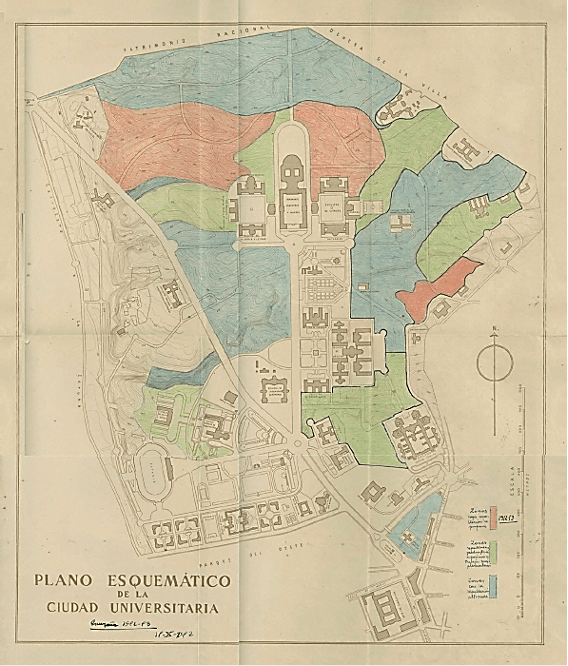
By the time the involvement of the Patrimonio Forestal del Estado ended in 1956, the campus was still far from resembling the idealised future projected in the 1943 model. In the following decades, new faculties and student residencies gradually transformed the Ciudad Universitaria, while the original idea of the campus as a ‘university park’ was progressively abandoned.[8] However, the slow growth of vegetation —together with the expansion of the built environment— ultimately concealed many of the scars left by the war on the landscape. The trenches and devastated battlefields represented in the model preserved today at the Faculty of Medicine disappeared beneath trees, gardens and new buildings.
Santiago Gorostiza, Alejandro Pérez-Olivares and Daniel Oviedo Silva met while studying at the Universidad Complutense de Madrid. They now work, respectively, at Lunds Universitet, Universidad de La Laguna and Universidad Pública de Navarra. José María Sánchez Laforet also studied in this campus and now works at the Architecture School as Assistant Lecturer.
[1] See, among others, P. Chías Navarro, La Ciudad Universitaria de Madrid: Génesis y Realización [Madrid’s University City: Origin and Development] (Madrid: Editorial de la Universidad Complutense, 1986); C. Rodríguez-López, Paisajes de una Guerra: La Ciudad Universitaria de Madrid [Landscapes of a War: Madrid’s University City] (Madrid: Servicio de Publicaciones. Universidad Complutense de Madrid, 2015); R.R. Tranche, La Ciudad Universitaria de Madrid y la Casa de Velázquez: escenas y huellas de una guerra [Madrid’s University City and the Casa de Velázquez: Scenes and Traces of a War] (Madrid: Ediciones Complutense, 2022).
[2] T. Sánchez de Lerín García-Ovies, Modesto López Otero. Vida y obra [Modesto López Otero: Life and work] (PhD Thesis, Universidad Politécnica de Madrid, 2000), pp. 28, 87, 156, 190 and 221; Chías Navarro, La Ciudad Universitaria de Madrid [Madrid’s University City], pp. 63–65, 79.
[6] P. Bernasconi, ‘A Fairy Tale Dictator: Children’s Letters to the Duce’, Modern Italy 18 (2) (2013): 129–40; M. Armiero, A Rugged Nation: Mountains and the Making of Modern Italy (Knapwell: The White Horse Press, 2011), pp. 88–93.
[3] J. Ibáñez Martín, ‘Un Año de Política Docente’ [One year of educational policy], Revista Nacional de Educación (October 1941): 26.
[4] P. García-Escudero, ‘Creación de un parque en los terrenos de la Ciudad Universitaria’ [Creation of a park on the grounds of the University City], Revista Nacional de Educación (Nov. 1941): 100-101.
[5] On the Francoist monuments to the fallen, see Del Arco Blanco, M.Á. (2022) Cruces de memoria y olvido: los monumentos a los caídos de la Guerra Civil Española (1936-2021) [Crosses of Memory and Oblivion: The Monuments to the Fallen of the Spanish Civil War (1936–2021)]. Barcelona: Crítica.
[7] ‘Repoblación forestal de la Ciudad Universitaria’ [Reforestation of the University City], FDM-MAPAMA, box 1742.
[8] Chías Navarro, La Ciudad Universitaria de Madrid [Madrid’s University City], pp. 225–53.

