In this blog, the first of two responding to Libby Robin’s essay in Global Environment’s new ICEHO series ‘Building Environmental History Around the World’, Margaret Cook describes her trajectory to becoming an ‘environmental-history pracademic’. A second essay by Harry Croft will be published in the coming days.
There is something about being in a different environment that gives you time to pause and reflect on your life and those of others around you. In 2013 I relocated from Ipswich in Southeast Queensland, Australia, to Helsinki, Finland, with my husband Nick and our two primary-school-aged sons and we lived there for a year. Dislocated from home, other family and friends and unable to work, I found hours of walking and thinking time, pondering what I wanted to do next.
As Libby Robin writes, in Australia, environmental historians have come from different backgrounds. Libby from history of science, Tom Griffiths and Grace Karskens from public history, Katie Holmes from women’s history, and Heather Goodall from Indigenous studies. They were all trail blazers in Australian environmental history. I too came from public history after 25 years working as a heritage consultant. I brought my expertise in reading built environments and landscapes together with a familiarity with archives of the environment to my Ph.D. study of floods in Southeast Queensland at the University of Queensland (2015–2018).
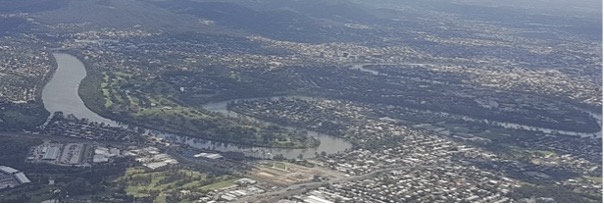
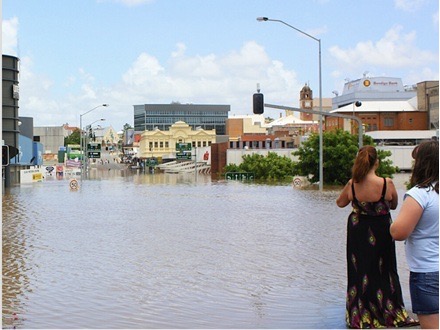
I was provoked by the 2011 flood in Brisbane (Queensland’s capital), which was popularly (and inaccurately) described as unprecedented and blamed on engineers for dam mismanagement. From my knowledge of the city’s history, this reflected an environmental history falsehood of human hubris that nature can be controlled. Although Brisbane is marketed as the river city, the meandering Brisbane River that bisects the city centre is often overlooked in historical accounts. If mentioned, the river and its floodplains are, as Tom Griffiths has written, merely the stage on which human action is set. But, I wondered, what about the agency of the river? Where does this historical account acknowledge the need or rights of a sub-tropical river to flow and occupy its floodplain after heavy rain? Environmental history offered the ideal framework for this analysis.
This changed my intellectual trajectory. Brisbane-based environmental historian and colleague Jodi Frawley introduced me to an Aladdin’s cave of scholarship by Libby and those already mentioned, along with publications by Emily O’Gorman, Andrea Gaynor and Ruth Morgan, who were then shaping the field in Australian water histories. My dog-eared copy of O’Gorman’s Flood Country (2012), her history of the Murray-Darling Basin, is testament to her influence on my work.
Becoming part of an Environmental History Network
In 2016 I attended the National History Workshop at the Australian National University (I appear in the photo in Libby’s article) and a conference at Macquarie University, both of which were formative to my scholarship. I found environmental history scholars to be welcoming and generous in sharing knowledge and they equipped me with a huge reading list. River histories by Sara Pritchard (Confluence, 2011), Marc Cioc (The Rhine, 2006), David Blackbourn (The Conquest of Nature, 2006), Donald Worster (Rivers of Empire, 1985), and Richard White (The Organic Machine, 1995); and the edited collection by Stéphane Castonguay and Matthew Evenden (Urban Rivers, 2012) expanded my thinking internationally and added the prisms of science and technology studies and urban history.
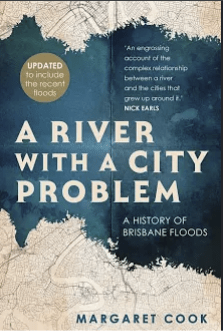
I soon began to interrogate the term ‘natural disasters’, applying the thinking of Stephen Pyne (Burning Bush, 1991) and Tom Griffiths (Forests of Ash, 2001) in their histories of fires. This led to the literature of political ecologists – including Uwe Lűbken, Mark Pelling, Ben Wisner, Greg Bankoff and Craig Colten – who have written on floods and other disasters. My book, A River with a City Problem: A History of Brisbane Floods (2019), grew from my doctoral research. My work added to international scholarship demonstrating that floods are cultural and political, shaped by human actions to build on floodplains and to manage floods with engineering rather than curb human behaviour. I then co-published an edited collection, Disasters in Australia and New Zealand (2020).
I actively participated in the Australian and Aotearoa New Zealand Environmental History Network (AANZEHN). During my membership, AANZEHN has been ably led by Jodi Frawley, Nancy Cushing, Andrea Gaynor, Emily O’Gorman and Alessandro Antonello, who all have fostered the discipline and upcoming scholars. As a beneficiary of the network’s collegiality, I agreed to help co-ordinate the ‘green stream’, the environmental history stream at the Australian Historical Association national conference, a task I did happily for five consecutive years. My goal was to provide an inclusive and welcoming place where we could share knowledge from the discipline of Environmental History. Film events, food and social functions encouraged networking as people from other historical disciplines joined our flock (not just for the food). The AANZEH network allows a sharing of research and activates us intellectually, offers a place to test new ideas, research and develop Environmental History, and mentor new scholars. Papers now presented reflect an expanding diversity of interests: First Nations people, economics, animals, mining, water, climate, science, agriculture and more.
Disaster studies, rivers and collaborating with First Nations people
In 2022 a post-doc provided the opportunity to work at Australian Rivers Institute in the School of Environment and Science at Griffith University, Brisbane, Australia, where I remain. The term Environmental Historian gives my work relevancy or comprehension to the scientists working at neighbouring desks. For me, environmental history sharpens my critical thinking towards things that need to be researched and understood in a climate-changing world. A central and ongoing tenett of my research is structured by the dynamic relationships between humans and the environment over time. From my early work with floods I have expanded to disaster studies and working with First Nations people on water histories and disasters.
Like many non-Aboriginal Australians, I am acutely aware of living on unceded Aboriginal and Torres-Strait Islander land and being the beneficiary of living on Country rich with a 65,000-year human history. Here historians can work with First Nations people to de-colonialise Australian history. I have worked in this field, inspired by the work of Heather Goodall, Grace Karskens, Deborah Bird Rose and Emily O’Gorman, who collaborated with First Nations people. In 2025 I started to research native grasses with Kamilaroi cultural knower holder, Kerrie Saunders, who wanted Aboriginal women’s history in northern New South Wales documented. Together we recorded their stories and knowledge of these grasses that once flourished on unregulated floodplains. The link between First Nations and environmental history is not new, but there is much more to be done.
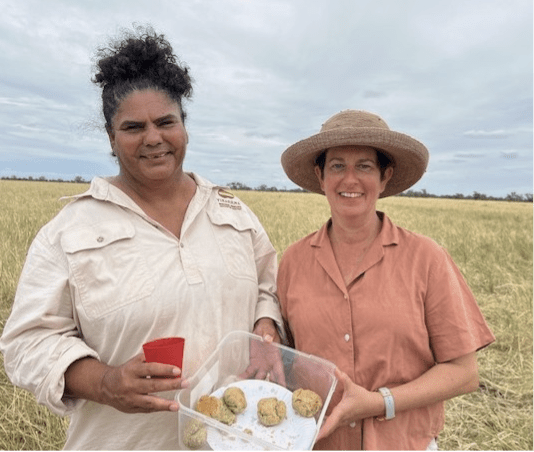
Figure 4. Standing with Kamilaroi woman Kerrie Saunders in a field in Moree, New South Wales, holding Johnny Cakes (scones) Kerrie has made with guli or native millet (Panicum decompositum), a native grass, 2025.
Oral history has been important in shifting away from the dominant Western hierarchy which prefers written documents over oral traditions. In 2024, I worked with a team at La Trobe University (Melbourne) with Katie Holmes and Karen Twigg on oral histories for the Murray-Darling Basin Authority (MDBA). Together we recorded and analysed interviews from seventy people living in the Basin, including Aboriginal people, graziers, irrigators, farmers, fishers, scientists and environmentalists. The work culminated in the website ‘Voices from the Basin’ (2025).[1] The MDBA is a science dominated body but, through this work, we witnessed a growing appreciation of oral history as valid environmental ‘data’, lived experience that did not to be triangulated with scientific records to be considered valid. The MDBA is currently reviewing its water policies with direct access to this environmental history research.
Engaging in and with interdisciplinary work
In Australia, academic institutions promote interdisciplinarity as a goal, although the reality often remains academic and professional silos. My background as a professional historian working in teams on consultancy projects has highlighted the benefits of having different disciplines contemplating the same issues. I find it both stimulating and challenging, drawing me into new avenues of inquiry. It creates far more than the sum of the individual parts. I have brought this approach into my work, having written academic articles with an engineer, town planner, journalist and First Nations people.
Working with others brings new research challenges and new audiences for our work. Like Libby, I have worked in the GLAM sector (galleries, libraries and museums) to take Environmental History beyond universities. In 2025 I collaborated with artist Kylie Stevens to produce Flood Lines, a multi-modal exhibition for the Ipswich Art Gallery that combined paintings, community stories, historical documents and photography, and Kylie’s paintings showing the impact of a swollen river on one place in Australia. Over 51 days, 6,952 people visited the exhibition and the art gallery’s social media campaign attracted 3,621 views on Facebook. The exhibition’s accompanying video has had 128 views.[2] It was a joy to conduct tours as people interacted with flood history and possible futures through art. Combing art and history provided a rare opportunity to visualise climate realities in ways that resonated with the general public.
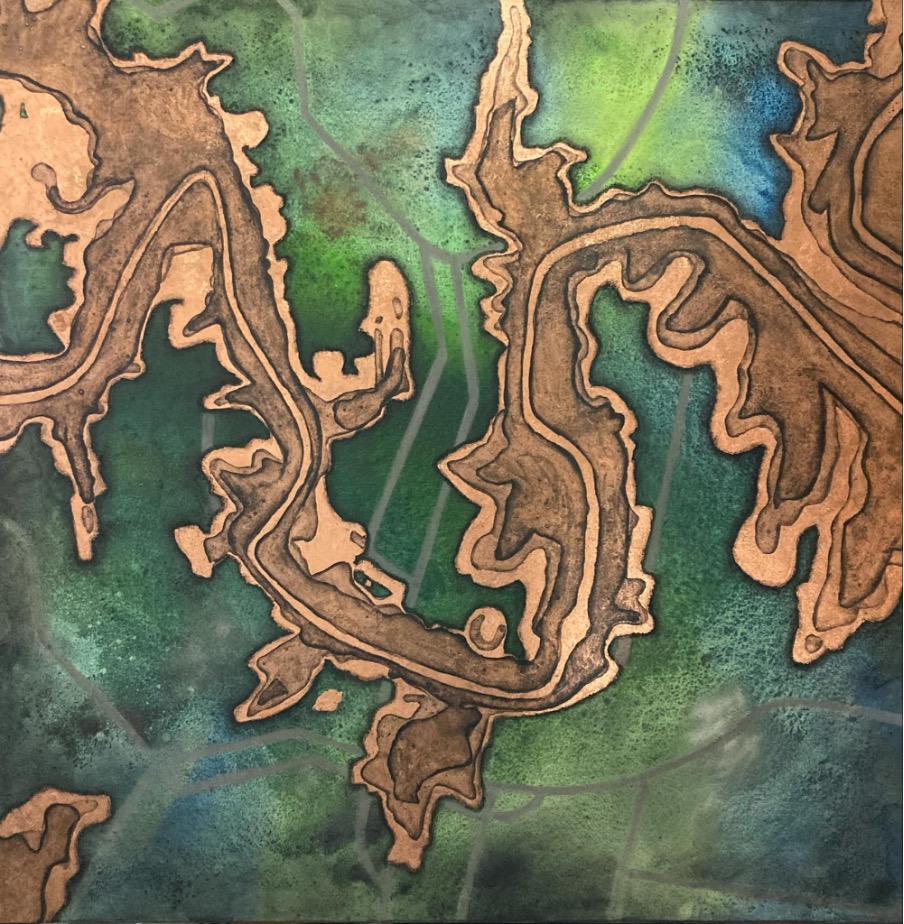
Now working in the space of climate-adaptation, I feel an imperative to engage with the broader community. The science is clear. Where I live, the warming climate could bring larger floods, hotter days over longer periods, and drier summers. Warmer waters will potentially create more severe cyclones that may travel south towards major population centres. Homes will be uninsurable and people will be left with no choice but to relocate. This raises issues of social justice, inequity and cultural obligation, often sidelined in neo-liberal policy decisions. Katie Holmes, Andrea Gaynor and Ruth Morgan’s article ‘Doing environmental history in urgent times’ (2020) expressed the need to address our climate crisis. I too feel a sense of urgency to educate and influence climate-adaptation behaviour and policy, informed by historical scholarship. While my research focuses on Australia, the findings resonate globally, in other places that face changes to the way people live in a changing climate, especially in settler colonies where people who did not understand the environment, changed it irrevocably.
An environmental-history pracademic
I regard myself as a pracademic, a hybrid of an academic researcher who translates scholarship with real-world experience as a practitioner. I bring my Environmental History research into conversations with other disciplines, technocrats, and policy makers. In 2026 I began a three-year Australian Research Council Early Career Industry Fellowship to develop a governance model of shared responsibility in disaster preparedness between government and communities. I have previously given five keynotes at professional water conferences, presented talks to more than forty community groups, and been interviewed on radio, television and in print. These interactions inform my research, the insights included the revised edition of A River with A City Problem, republished in 2023 with an additional chapter after the 2022 floods. There is a thirst in the community for knowledge and practitioners in the disaster space need evidence-based research to inform policy. I am working with the Queensland Reconstruction Authority and Natural Hazards Research Australia to reduce community vulnerability to climate-related risk. It is a two-way learning process as their experience informs my research and Environmental History brings cultural and social aspects and community perspectives to their policy-driven and science and engineering dominated worlds. It is an invaluable opportunity for multi-disciplinary collaboration with environmental history at its centre.
In water history, we are thinking more about the rights of rivers and nature more generally as living entities with legal personhood, rather than as human property or a resource. Rivers have the right to flow and, like humans, animals have the rights to shelter and food. In disaster research and policy there is a move away from a dependence on engineering to control rivers to ways of thinking about where people should live to ensure safety in a warming world that accommodates the needs of the environment. We are working more closely with First Nations people and perhaps we can take heed of their encouragement to listen to nature and walk together towards a better environmental future.
[1] Voices from the Basin, MDBA, 2025. https://www.mdba.gov.au/science-and-knowledge/voices-murray-darling-basin
[2] Flood Lines, Ipswich City Council, 2025. https://ipswichartgallery.qld.gov.au/exhibitions/flood-lines

