In this blog Harrison Croft dons his ‘stout pair of boots’ and takes environmental history out of the office’ in a second response to Libby Robin’s essay in Global Environment’s new ICEHO series ‘Building Environmental History Around the World’. Margaret Cook’s response was published on 9 June 2026.
The long and scorching summer is finally over. It’s March 2022 and I am one week into my Ph.D. candidature. I’ve already cobbled together an emergent literature review, read through some of the most salient secondary sources, and begun to make contact with a few enthusiastic archivists whose collections hold the key to my project’s success. So, what better thing to do than to abandon the desk, don the ‘stout pair of boots’, and get up close and personal with the river who is to be the subject of the next three-and-a-half years of concentrated research.
Taking a series of trains and buses three hours northeast of my suburban home in Melbourne, I arrive at Warburton, an old and quaint ex-gold rush town on the banks of Birrarung, the stream flowing down through the city of Melbourne and also known as the Yarra River. There, by the water’s edge, I begin unpacking my rucksack. It’s crammed full of clothes and food, a tent and sleeping bag, and—most important of all—a small dirigible rubber boat called a Packraft. I am shortly joined by my friend, and we inflate our rafts, set them up in the babbling stream, and embark on this multi-day journey downstream cheered on by kookaburras—Australia’s iconic laughing bird—and enveloped by swaying old eucalyptus trees.
Lazily succumbing to the river’s perennial current, I need not paddle too much here. There are some rocky outcrops to be avoided, and the banks are muddy and ensnared in thick and spiny unkempt brambles, but mostly it is a tranquil journey. Tranquil, that is, until we come up against the first of many interminable and seemingly impenetrable logjams.
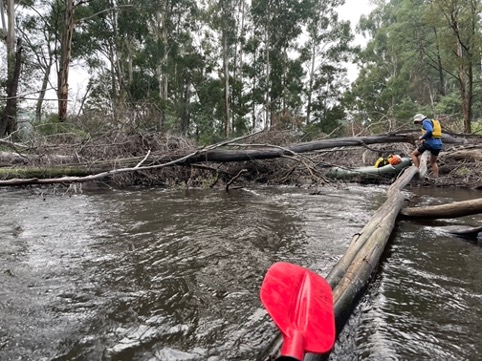
The logjam presents to the paddler a choice: to alight the boat, lift it bodily over the wooden encumbrance, and refloat at the downstream end; to leave the water entirely and drag the boat across the banks and through painful spiny bramble thickets; or to pass underneath the mess through the water. So dense were some of these logjams that each demanded a Sisyphean effort, amounting to hours of heaving, and called into question the sense of the whole expedition.[1]
And it is for its usefulness as an extended metaphor that the story of the logjam finds its way into this essay on the subject of the Australian environmental history Ph.D. The Ph.D. candidate often finds themself tête-à-tête with some seemingly impossible obstacle, casting serious doubt over the legitimacy of the project. Inaccessible archives, rabbit holes followed for weeks that mercilessly come up as dead-ends, and source materials so mildewed and rotted as to be totally illegible. These are seemingly universal of the experience of historical research.
My journey to the river as a research topic was long and languorous. But on reflection it is clear to me that water was always at the centre of everything. If flooding is at the heart of Brisbane’s relationship with its urban river, as Margaret shows; then Melbourne’s water history more often than not has been one of drought and water scarcity. Growing up during the Millennium Drought (1996–2009) first on the softly pebbled shores of Awaba/Lake Macquarie, a few hours north of Sydney; and later nearby Melbourne’s Port Phillip Bay, water—and its absence—always loomed large in my world. Sailing, kayaking and swimming occupied every weekend.
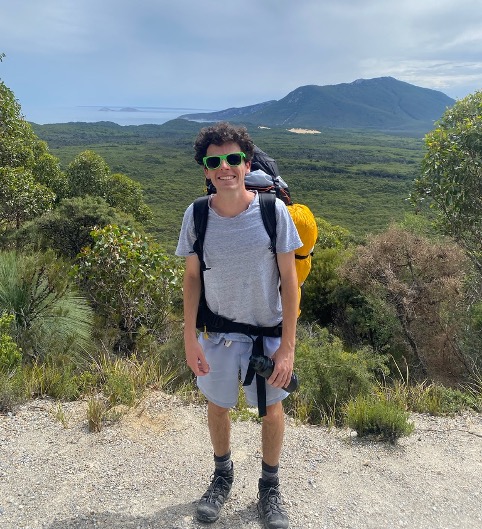
As the world was locked down in 2020, I completed a Bachelor of Education with majors in History and English. Although I had long had a fascination with history (my parents’ bookshelves comprised two genres: military history – think Christopher Hibbert on Lord Nelson, and Peter Fitzsimons on Australia in the First World War – and histories of endurance in the Antarctic and the Himālaya –Ernest Shackleton’s and Joe Simpson’s memoirs, among others —not exactly scholarly stuff!), it took me quite a while to begin to think of history as a job rather than an evening pursuit. It was thanks to a particularly flamboyant high school history teacher (aren’t they all?), and a great series of walking tours offered in a local history subject at Victoria University run by Robert Pascoe, that my interest in academic historical research was first piqued.
With one year left of my teaching degree, I reached out to Lynette Russell at Monash University to ask whether she might supervise a postgraduate project at the intersection of environmental history and Indigenous studies. As Libby points out, this is a common pairing, as Australian environmental historians are attendant to the continent’s long history of First Nations custodianship. Although Lynette agreed, an extra piece of paper in the form of an Honours degree in history was required of me first. This I attained at La Trobe University. It was at La Trobe that I first read Emily O’Gorman and Andrea Gaynor’s then-recently published influential and field-shaping ‘“’More-Than-Human Histories’”’ (2020). There I also met Katie Holmes and Lil Pearce—Australian environmental historians best-known for their work uniting environmental and gender history—who warmly encouraged my thinking on how environmental activism and environmental history might speak together. My own emergent work on environmental history has so far sought to highlight historical acts of resistance to environmental exploitation, and is inspired by activist academics across the world.
Lynette, as well as my other Ph.D. co-supervisors, Rohan Howitt and Leigh T. I. Penman, were extremely encouraging of my multidisciplinary dalliances. Drawing on scholarship from archaeology, geomorphology, queer ecologies, hydrology and the environmental humanities (straddling ecofeminism, philosophy, anthropology and history) sharpened my argument and allowed me to see the river through multiple angles. But it was always foremost an environmental story I wanted to tell. The river today is badly polluted and discoloured, and settler colonialism played out along Birrarung’s banks with environmental particularity, but understanding the historical processes triggered by the Europeans’ arrivals resulting in this apparent neglect was my key motivation.
Apart from my supervisor’s own work (including Roving Mariners, 2012; and, with Ian McNiven, Appropriated Pasts, 2005), the texts that influenced me the most were Emily O’Gorman’s Wetlands in a Dry Land (2021), Jason W. Moore’s Capitalism in the Web of Life (2015), and, quite simply, any words William Cronon has ever penned. Engaging with Cronon taught me what brilliant and gripping historical writing can look like, while Moore showed me that there was a place in the scholarship for incisive writing on the historical dimensions of the climate crisis. O’Gorman taught me the value of a more-than-human methodology, all wrapped in beautiful exposition. The field when I first commenced my Ph.D. project was interested in pushing this notion of more-than-human relationality further, grappling with issues of accounting for historical non-human agency, and uniting environmental and gender histories, and the histories of emotions.
The Australian environmental history scene is exceptionally lively, and the friendly engagement of its diverse membership is its greatest strength. Conferences and workshops prove stimulating melting pots, and so much of my thinking is due to those informal conversations, whether at the Australian Historical Association’s annual conferences, the 4th World Congress in Oulu in 2024, or any number of other meetings over the years. Australian environmental history has always had an outsized impact on the global scholarship, not least due to Libby’s advocacy work: the world congresses are organised by the ICEHO, which she helped to establish.
But it is not all happy news. The days of free tertiary education have long since passed. Although I was fortunate to win a fully funded scholarship to pursue my postgraduate studies, the Bachelor of Arts is a woefully expensive piece of paper in Australia. The Australian Historical Association has been leading a campaign to have the act that saw Arts degrees more than double in 2021 repealed.[2] In Australia, as elsewhere, research and teaching jobs in universities are rare. The higher education sector exploits high fee paying international students, and has been plagued by mismanagement by external consultants and vice chancellors on bloated salaries. Even in these dire conditions, Australian environmental historians continue to produce groundbreaking scholarship.One of the great particularities of the development of the field of environmental history in Australia is its inseparability from Indigenous history. Alongside Tom Griffiths, Libby has done much to shape this, and their work sits beside the late Heather Goodall’s Rivers of Resilience (with Allison Cadzow, 2004) and Georges River Blues (2023), as well as Deborah Bird Rose’s and Val Plumwood’s works in the multidisciplinary environmental humanities in entangling the struggles of environmental justice and Indigenous sovereignty. Indeed, one of Australian environmental history’s hallmarks is its attention to justice. It has a decidedly activist flavour best captured in Katie Holmes, Andrea Gaynor, and Ruth Morgan’s powerful phrasing, penned at the outbreak of the COVID-19 Pandemic, that “there is no justice without history”.[3] Whereas my Ph.D. project was on the local case of Birrarung—explaining how more-than-human worlds unsettled the settler colonial project in the nineteenth and twentieth centuries—since arriving at Universität Augsburg to take up a Humboldt research fellowship in global environmental history and environmental humanities, hosted by Simone M. Müller, in November 2025, I have taken on a larger project, examining different historical approaches to environmental activism globally in the Capitalocene.
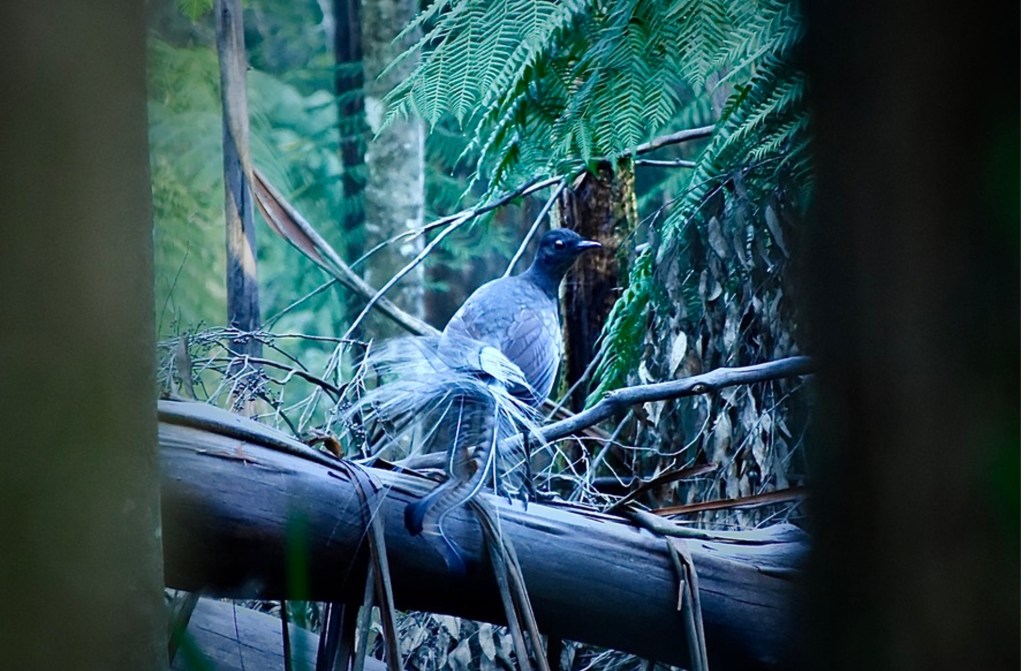
Alongside this work on historical environmental activism, Augsburg is also supporting my interests in uncharismatic species in environmental history. The university will soon host a workshop on the subject, bringing together scholars from around the world to theorise how uncharisma has been constructed by different people, and applied to different species in different ecological contexts. In this way, it is exciting to see how the field continues to be redefined and is always asking new questions of the past.
Of course, what strikes me as the main difference in Libby’s and my career trajectories is the urgency of the work of the environmental historian now. Whereas the leading climate science as Libby was writing her first book in the 1990s projected worrying trends and cautioned world leaders to stem emissions, we are today living through the realities of those ignored warning signs. The well-trod path of the academic historian from dissertation to lectureship and professorship is, in an age rife with AI-misuse, the rise of the far right, disinformation and poisoned atmospheres, a distant fantasy. And yet I remain an optimist by nature. The work we do matters on local, regional and global scales. It matters to those who already visited the river, and those who might swim in and drink from the river’s waters many decades from now. I do this work because it feels urgent and I hope it makes a difference, and I love the work.
Now it’s March 2026. Four years have passed since I first paddled downriver with my friend. With another degree under my belt, I’m now in Augsburg, in southern Germany. I’ve traded Melbourne’s polluted ‘upside down’ river for Bavaria’s Zugspitze and the Lech and Wertach rivers. A few weeks ago, one of the Zugspitze ski field’s chairlifts was deconstructed: it had been built to service a ski run that, due to climate change, is no longer safe to ride.[4]
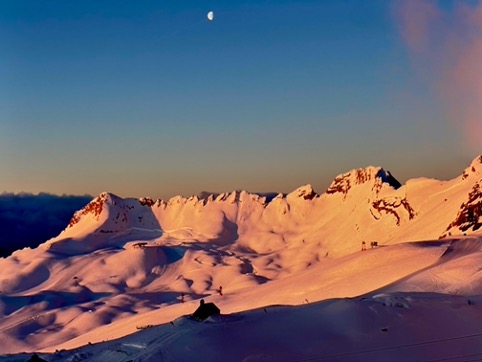
I am never far from the water. In the winter I ski the snow from frozen water. In the spring it melts and flows through the forest at the edge of the city of Augsburg. I walk through the forest each day on my way home from the office. The migratory birds have returned to build their nests, the flowers bloom and leaves return. The northern hemisphere’s summer will be marked by record heat: we will again temporarily breach the 1.5ºC limit, and thousands will die in homes and cities ill-equipped for unrelenting heat.[5] In autumn the leaves will die. The days will shorten, and the shadows will lengthen. The river will still be there.
[1] Harrison Croft, ‘What the River Taught Me: (Mis)adventures and Lessons in Pack-rafting Preparedness”, Lot’s Wife no. 5 (2022): 20–23. https://lotswife.com.au/what-the-river-taught-me-misadventures-and-lessons-in-pack-rafting-preparedness/ (accessed 28 April 2026).
[2] Australian Historical Association, ‘Advocacy: The 2024–25 Budget and the Job-Ready Graduates Package, 2024’: https://theaha.org.au/advocacy-the-2024-25-budget-and-the-job-ready-graduates-package/ (accessed 18 May 2026).
[3] Katie Holmes, Andrea Gaynor and Ruth Morgan, ‘Doing Environmental History in Urgent Times’, History Australia 17 (2)(2020): 237.
[4] Bayerische Zugspitzebahn Bergbahn AG, ‘Schneefernerkopflift: Dismantling of the Glacier Lift’, 2026: https://zugspitze.de/en/Our-mountain-worlds/Highlights/Glacier/Schneefernerkopflift_EN (accessed 29 April 2026).
[5] World Meteorological Organisation, ‘WMO: Likelihood Increases of El Niño’, 24 April 2026: https://wmo. int/media/news/wmo-likelihood-increases-of-el-nino (accessed 30 April 2026).

